- Order my new book Passion Struck
- Click Here

Understanding the science and practical application of habit stacking can revolutionize your daily routine, setting you on a path to personal growth. This powerful strategy leverages existing habits as a foundation for introducing new ones into your life.
In this article, I will delve into the neuroscience behind habit formation, specifically exploring synaptic pruning’s role in reinforcing current habits while eliminating unused ones. I’ll also demystify how habit stacking works by using examples from everyday activities such as brushing teeth or taking lunch breaks.
I will then introduce five micro habits that have the potential to supercharge your personal development when incorporated into your daily schedule through habit stacking. Lastly, I’ll equip you with strategies to overcome resistance to change and maintain consistency in your new routines.
This journey will enhance your understanding of how habits shape our lives and empower you with actionable insights on leveraging them for optimal personal growth through effective habit stack creation.
Have you ever wondered why sticking with new habits is so tough? It turns out our brains are wired in a way that makes habit stacking a genius strategy for creating intentional behavior change. This technique taps into how our brains prune away unused connections between neurons, helping us develop general habit stacks by piggybacking on existing ones.
Let’s get nerdy for a moment. Synaptic pruning is like Marie Kondo for your brain. It tidies up by removing weak connections and strengthening the ones you use the most. It’s like decluttering your neural pathways, making room for the habits that matter.
This pruning process is crucial for habit formation. When you repeat an action or thought, your brain says, “Hey, this is important.” and reinforces the neural pathways responsible. The more you repeat, the stronger the connection becomes, and voila — you’ve got yourself a habit.
A study from Oxford University suggests that our brains love routines, which means once we’ve developed daily habits like brushing our teeth or eating breakfast, they become effortless because they’re ingrained in our neural pathways.
Habit stacking works by associating a desired behavior with an existing routine — creating shortcuts for future behavior change. The trick lies in how easily our minds link related activities, making it simpler to remember what needs to be done next without relying on willpower alone.
In his book “Atomic Habits,” author James Clear explains it perfectly: “Habits are mental shortcuts learned from experience.” So, if you want your mind to automatically guide you towards healthier choices, integrate them into your current daily schedule instead of relying solely on determination. It’s like getting a two-for-one deal on self-improvement.
Instead of reinventing the wheel, look at your daily routine and find an established habit that can serve as a trigger for your desired behavior change. Take advantage of the already-established routine of drinking your morning coffee to create a platform for introducing another healthy habit.
Our brains love patterns, so when we repeat actions over time, they become automatic. You’re taking advantage of this built-in autopilot mode by stacking a new habit onto an existing one.
According to James Clear, cues are the secret sauce for forming new behaviors. They’re like little reminders that nudge your brain into action. So, why not create cues from your current routines?
Habit stacking works because it follows the simple rules of behavior design. Integrating small changes into familiar routines makes you more likely to adopt them and succeed in the long run. Why not experiment to see how you can combine your habits for a more improved version of yourself?
Habit stacking is not just a theoretical construct but a practical tool that seamlessly integrates into your daily routine. By taking advantage of our current behaviors, we can build new healthy habits onto existing ones. This method allows us to develop general habit stacks and make significant strides towards personal growth.
A morning routine is something most people already have in place — whether it involves brushing teeth, drinking morning coffee, or eating breakfast. The beauty of habit stacking lies in its simplicity; you add a new behavior immediately after an existing one.
For instance, if you’re trying to cultivate the habit of journaling for self-reflection and mindfulness, stack this with your daily toothbrushing ritual: once you finish brushing your teeth each morning (existing habit), spend five minutes writing in your journal (new behavior).
If you enjoy morning coffee, consider using this time to set goals for the day or read a chapter from an inspiring book — both great examples of how habit stacking works.
Your lunch break also presents ample opportunities for implementing healthy behaviors through habit stacking. Instead of mindlessly scrolling through social media while eating (which isn’t conducive to mindful consumption), try incorporating healthier alternatives such as taking a short walk post-lunch or practicing mindfulness during mealtime.
For example, instead of rushing back to work right after finishing lunch (current behavior), take 10 minutes for deep breathing exercises or meditation (new behavior). These small changes might seem insignificant initially, but remember — health habits accumulate over time, leading to profound transformations.
Micro habits may seem small, but their impact on personal growth is nothing short of heroic. By incorporating these five powerful micro habits into your daily routine through habit stacking, you can unleash their true potential:
Embracing these micro habits with intention and consistency will supercharge your personal growth journey. Remember that even the smallest actions can have a profound impact when they become integral parts of your daily life. So, unleash the power of these micro habits and watch them transform you into the best version of yourself.
How do you incorporate many habits into these busy lifestyles that we all have?
Think about your daily schedule: wake up, brush your teeth, have a morning cup of coffee while checking emails, or go through your to-do list.
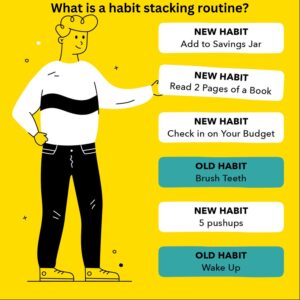
These are all established habits that you do without thinking. Now, let’s add a mini-habit into this routine — like jotting down three things you’re grateful for in a habit journal while sipping your coffee. It’s straightforward, swift, and it will be a fundamental component of your morning regimen.
This approach helps discipline oneself without needing constant reminders and sparks creativity. It’s like a double shot of espresso for your brain.
Habit stacking works because it takes advantage of how our brains build connections. Linking one action directly to another expedites learning and makes it easier.
Habit stacking is like a game plan for your daily routine. But just like in any game, there are different strategies you can try out to win at building healthy habits. Let’s examine these techniques.
Begin by taking small steps and gradually increase the difficulty level. Consistency is key, so don’t worry about being perfect right away. And if you need some extra help, try using habit-tracking apps like HabitHub.
They’ll keep you on track and give you a virtual high-five for your progress. So stack those habits and watch your life transform, one tiny habit at a time.
Habit stacking is an effective way to cultivate self-improvement, yet it presents some difficulties that can be overcome. Don’t worry, though. These hurdles are totally conquerable. With the right mindset and strategies, you can make habit stacking work like a charm.
Resistance to change is a common roadblock when trying to add new habits to your routine. Our brains like to stick to what’s familiar, but we can outsmart them.
A study published in the Journal of Experimental Psychology found that our past behaviors heavily influence our future behavior. This is due to cognitive biases like the status quo bias and inertia.
To overcome these biases, start small with your habit stack. Remember, tiny changes can lead to remarkable results over time, just like in Robin Sharma’s book The Five AM Club.
The second challenge is staying consistent with your new habits, even when life throws curveballs your way.
If you miss a day, don’t beat yourself up. Just get back on track as soon as possible. Research shows that missing one opportunity won’t significantly impact the habit formation process. What matters most is getting back into your routine promptly after a disruption.
So, if life derails you occasionally, don’t sweat it. Just jump back into your habit stack without self-criticism holding you down.
Persistence is key when it comes to developing healthy habits through habit stacking. Small steps taken consistently lead to significant improvements over time. Be patient with yourself on this journey.
When you habit stack, you’re basically playing Jenga with your daily routine, but instead of toppling over, you’re building a tower of success. It’s like a magic trick that turns small changes into big wins.
Remember, habit stacking is a marathon, not a sprint. It takes time and consistency to see real results. But trust me, it’s worth it. So keep stacking those habits, and watch your personal growth soar.
In conclusion, the journey of personal growth is not always about monumental changes or grand gestures; instead, it is often the accumulation of small, powerful habits that pave the way for significant transformation. Just like tiny superheroes, micro habits possess an incredible ability to shape our lives, propelling us towards our aspirations and fostering a more fulfilling existence.
You can tap into their immense potential by incorporating the five micro habits discussed in this article into your daily routines through habit stacking. The beauty of micro habits lies in their accessibility and sustainability. You can all incorporate them into your daily routines, regardless of how busy or demanding our lives may be. With each small victory achieved, you accumulate a reservoir of positive change that gradually, yet powerfully, influences your personal growth journey.
So, let us unleash the mighty potential of these micro habits, embracing their impact on our lives with open arms. As we do so, we embark on a path of continuous self-improvement that leads us toward becoming the best versions of ourselves. With dedication and perseverance, these tiny yet potent habits will undoubtedly supercharge our personal growth, making our lives more fulfilling, intentional, and truly extraordinary.
I hope you found this short guide on habit stacking useful.
As a new reader, please check my personal growth and well-being stories reflecting my reviews, observations, and decades of research and interviews.
The Power of Choice, Overcoming Traumatic Brain Injury, Reverse Aging, Significance, Optimal Anxiety, Person of Courage, The Power of Hope, Being Stuck, Curiosity, Awe, 5 AM Club, Strong Moral Compass, Psychological Immune System, Playing The Long Game, Drama Addiction, Trust Building Exercises, Taking The Road Less Traveled, Why Passion is the New Currency, Unreseasonable Hospitality, Five Senses, Digital Addiction, When to Quit, Effortless Perfection, Mental Immunity, Sensory Experiences, The Value of Struggle, Overcome Challenges, Victim Mentality, Anger Management, Gratitude, Vulnerability, Free Will.
You might find more information about my professional background. You can listen to the #1 Alternative Health Podcast, Passion Struck, with John R. Miles. You may join Medium with my referral link to enjoy unlimited content.