

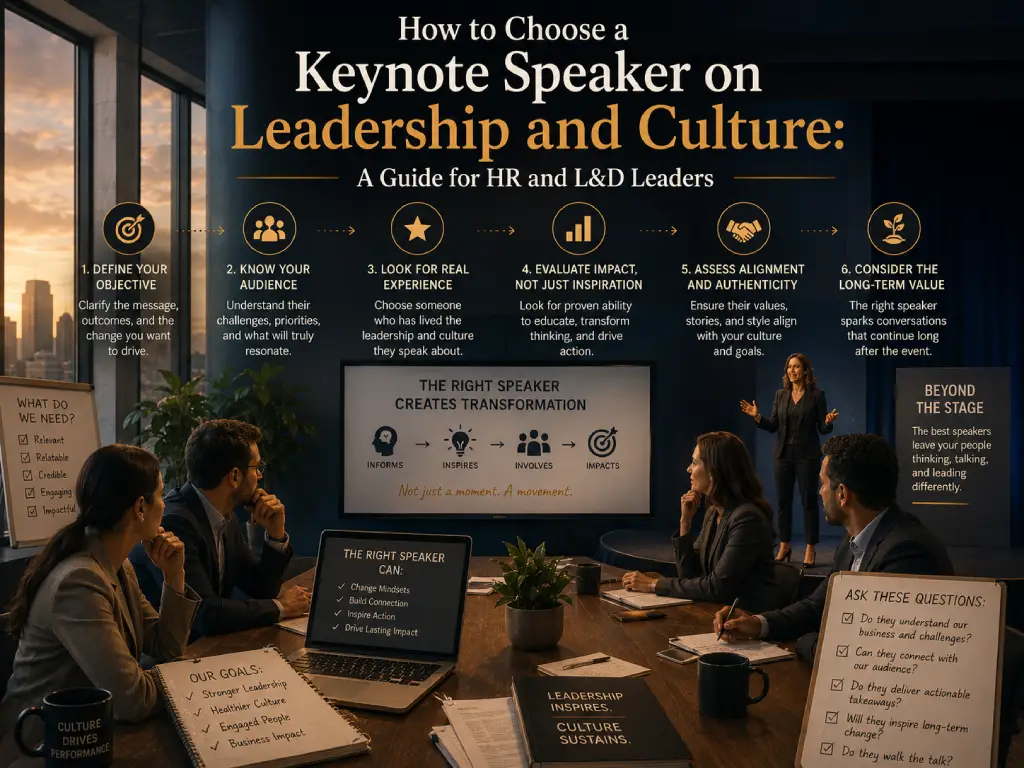
The brief you write before booking a keynote speaker on leadership matters more than the speaker you book.
That is not a knock on keynote speakers. It is a recognition that the most expensive mistakes in corporate event planning do not come from choosing the wrong person. They come from choosing the right person for the wrong reason, or worse, the right person for a problem you never clearly defined.
After 200+ keynote engagements at companies like Oracle, JPMorgan, FedEx, Dell and Lowe’s and after speaking to more than 240,000 attendees, I have watched organizations waste enormous budgets on speakers who checked every visible credential and still left the room unchanged. I have also watched relatively unknown speakers walk into a room and shift how an entire leadership team thinks. The difference is almost never the speaker’s fame. For a deeper look at what drives real transformation, see the work of John R. Miles — a keynote speaker on leadership and culture whose frameworks have been applied at some of the world’s leading organizations.
This guide is written from the inside. Whether you need a keynote speaker on leadership for an executive summit, a leadership offsite, or a company-wide culture initiative, use it to find the right speaker faster, evaluate proposals more precisely and increase the likelihood that what happens in that room continues after everyone goes home.
Start with the Outcome, Not the Speaker
The most common mistake HR and L&D leaders make when selecting a keynote speaker on leadership is starting with the name.
A speaker with strong name recognition may have built that recognition through a book, a TED Talk, or a media cycle. None of those credentials answers the most important question: what specific change do you need in your audience after they leave the room?
Before you look at a single speaker profile, define your desired outcome in a single sentence. Not a theme. Not a topic. A behavioral outcome.
For example: we need our mid-level managers to understand why employees feel invisible and leave with a framework they can apply in their next one-on-one. Or: we need our senior leaders to understand what it costs the organization when people feel invisible and what they personally can do differently.
Once you have that sentence, every speaker evaluation becomes more precise. You are not asking, “Is this person inspiring?” You are asking, “Does what this person teaches match what we need our people to do?”
The Three Evaluations That Matter
Once you have clarity on your outcome, evaluate every keynote speaker on leadership through three lenses.
1. Credibility Alignment
Does the speaker’s background match the challenges your audience actually faces? A speaker who works primarily with entrepreneurs may not land well with a room full of mid-level corporate managers. A speaker who focuses on individual resilience may not serve a leadership team trying to diagnose a systemic culture problem.
The most credible keynote speaker on leadership for your audience is the one who has been inside the specific tension your organization is navigating. Former executives who have led through culture transformation have a different texture of authority than those who have not carried that responsibility. That texture is what audiences recognize and respond to.
2. Framework Over Anecdote
A great story creates an emotional experience. A great framework creates behavioral change.
The best keynotes offer both, but the framework is what the audience carries out of the room. When evaluating a speaker, ask: What is the specific model, system, or framework this person teaches? Can I articulate it in two sentences? If not, the audience probably will not be able to either.
When evaluating any speaker, ask for their core framework by name. If they do not have one, what they are offering is motivation. Motivation fades. Frameworks compound.
3. Customization Depth
A speaker who asks about your company, industry, audience and specific challenge before an engagement is investing in relevance. A speaker who sends a generic questionnaire and shows up with the same deck they used last week is offering convenience, not transformation.
Ask every speaker candidate: “What will you do differently for our audience specifically?” Their answer will tell you everything.
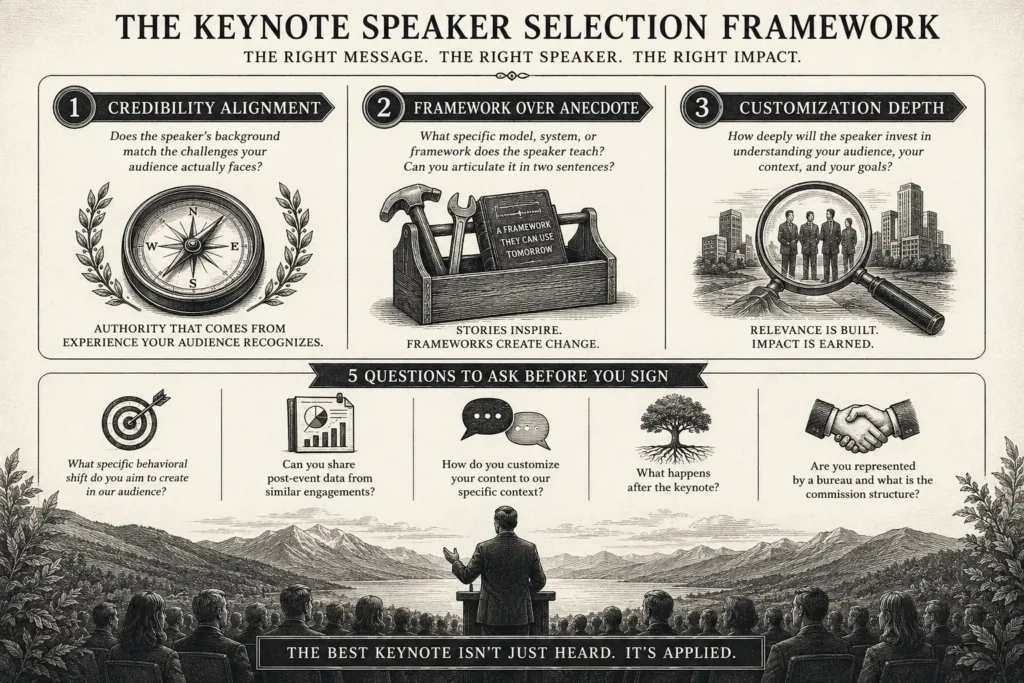
Questions to Ask Before Signing Any Contract
These are the questions that separate thorough HR leaders from those who will need to explain a poor investment to their CFO.
What specific behavioral shift do you aim to create in our audience?
If the answer is vague, press further. If the speaker cannot name the specific change they are trying to create, they will not create it reliably.
Can you share post-event data from similar engagements?
Not testimonials. Data. Engagement scores before and after, follow-up survey results, and specific examples of how organizations applied what was taught. Speakers who invest in measuring their own impact are the ones whose impact is real.
How do you customize your content to our specific context?
Outstanding speakers will ask about your organization’s current challenges, the audience’s professional level, any recent events that affected morale or direction and what you have already tried. They use this to build relevance into the content, not to perform relevance on stage.
What happens after the keynote?
A 60-minute keynote cannot change a culture by itself. Ask whether the speaker offers follow-up resources, workshop components, or tools that extend the impact. The best engagements are designed as an entry point, not a conclusion.
Are you represented by a bureau and if so, what is the commission structure?
Speaker bureaus provide a useful service, but they typically add 20-30% to the speaker’s fee. It is worth knowing whether that cost is embedded in the quote or added on top.
The Difference Between Motivation and Transformation
Every year, organizations spend millions on keynote speakers and report that their culture has not changed. This is not because keynote speakers are ineffective. It is because most organizations hire for motivation when they need transformation. A skilled keynote speaker on leadership creates lasting behavioral change, not just inspiration.
Motivational speakers are energizers. They move an audience emotionally. They are valuable for certain moments, particularly at the opening of a conference when you need the room to be awake and engaged. What they do not reliably produce is behavioral change that persists into the following week.
A transformational keynote speaker on leadership creates a different kind of moment. They name what is actually happening in the audience’s professional lives with enough specificity that people recognize their own experience in the words. They offer a framework that reframes how the audience understands the problem. And they leave the audience with something concrete to do differently. This connects directly to the principle of mattering at work — the evidence-based insight that people perform best when they know their contributions are seen and valued.
According to research published by the Association for Talent Development, keynote experiences that combine emotional resonance with a transferable framework produce 2.4 times higher post-event behavioral change than keynotes that prioritize motivation alone.
Red Flags to Watch For
The highlight reel substitutes for a conversation. If a speaker’s team sends you a sizzle reel but will not make the speaker available for a pre-event call, that tells you something about how the engagement will be managed.
The topic does not shift with the audience. A speaker who cannot articulate a different angle for your specific audience than the one they use for everyone else is not customizing. They are reusing.
The resume sells the story, not the framework. Credentials matter. But if the primary credential is “survivor of an extraordinary event” without a transferable model for the audience, the room will be moved but not changed.
They cannot tell you what the audience will do differently on day one back at work. If the speaker cannot name a specific, concrete behavior change they are engineering, they are engineering feelings. Feelings matter. But they need a framework to travel on.
Making the Investment Last
A keynote speaker on leadership is a beginning, not a conclusion. The organizations that see the highest return on their speaker investment are the ones that treat the event as a catalyst.
They brief their internal teams on the speaker’s framework in advance. They create pre-event conversation prompts. After the keynote, they build structured follow-through, asking managers to apply one element of the speaker’s framework in the next month and then report back. They create internal discussion guides tied to the content.
When you build that infrastructure around a keynote, you are not hoping the message sticks. You are engineering it to stick. The ultimate goal is to create a culture of mattering — one where your people feel seen, valued, and driven long after the event ends.
Frequently Asked Questions
How far in advance should we book a keynote speaker for a corporate event?
For high-demand speakers in the leadership and culture space, booking 4 to 9 months in advance is advisable. For flagship annual events with a specific speaker in mind, 12 months is not uncommon. Earlier booking also gives more time for pre-event customization, which significantly increases impact.
Is it better to use a speaker bureau or book directly?
Both have advantages. Bureaus handle logistics, contracts and backup options if a speaker cancels. They typically add a commission of 20-30%. Booking directly allows for more personal relationship-building and can be more cost-effective if you know exactly who you want.
What is the most important factor in choosing a keynote speaker on leadership and culture?
Alignment between the speaker’s framework and your specific organizational challenge. Name recognition is far less predictive of impact than whether the speaker has a concrete model for the exact problem your audience is navigating.
How do we evaluate whether a speaker’s content will transfer to behavioral change?
Ask the speaker to describe a specific behavior your audience will engage in differently within 30 days of the keynote. If they cannot articulate a specific behavior, they are offering inspiration rather than a behavioral change system.
What questions should we ask a speaker’s previous clients?
Ask: Did the audience reference the content in the weeks or months after the event? Did leaders change any specific behaviors as a result? Would you bring this speaker back and why or why not?
How should a keynote on leadership and culture connect to our L&D programming?
The keynote should introduce or reinforce a framework that your L&D programming can then develop further. The best uses of keynote speakers in corporate settings treat the keynote as an anchor — it names the central challenge and framework, and subsequent programming gives people the skills to apply it.
Choosing the right keynote speaker on leadership is one of the highest-leverage decisions in your event planning calendar. Get it right and it creates a shared language, a shifted perspective and a reference point your team returns to long after the event.
If you are looking for a keynote speaker on leadership who brings a research-backed framework for building a culture where people genuinely matter, explore our leadership and culture keynotes.