
If you are evaluating what makes an effective keynote speaker on culture, the answer starts with a distinction most event planners discover too late. You know what the next 24 hours look like. The room is energized. People leave the event feeling ready to tackle something. There are comments in the hallway about how good it was. And then, slowly, the energy dissipates. By Wednesday, nothing has changed. By the following month, you would be hard-pressed to name three specific things the speaker said.
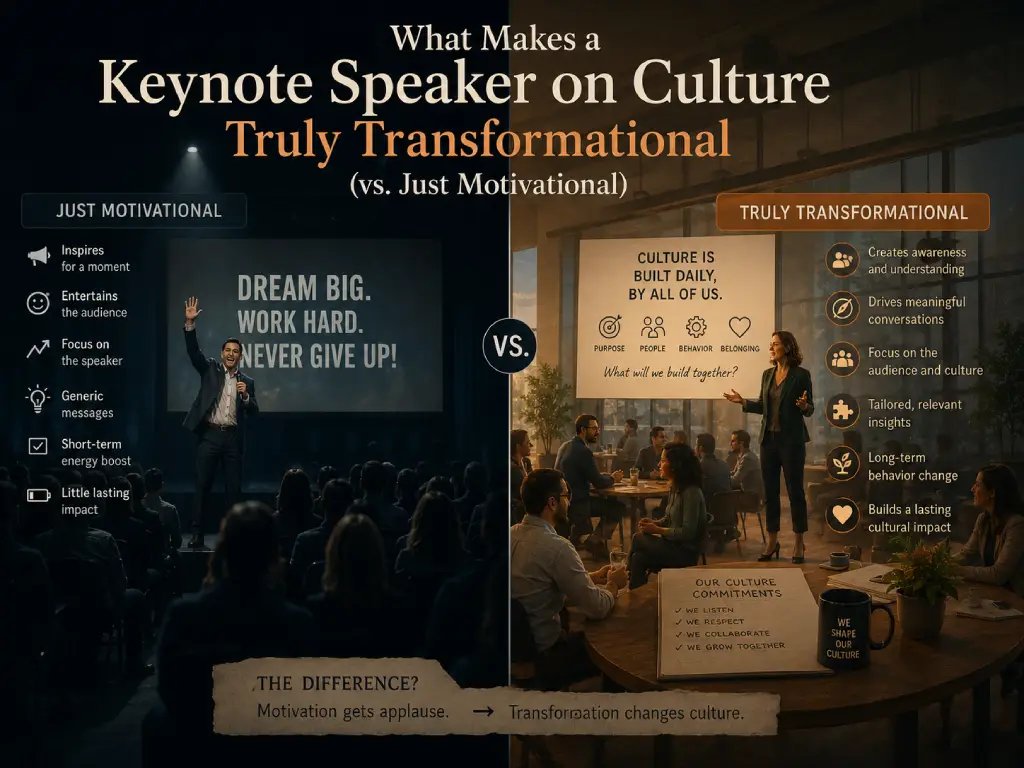
The difference between a motivational speaker and a transformational keynote speaker on culture is simple: motivational speakers change how people feel during an event; transformational speakers change how people think and behave long after the event ends. The best transformational speakers combine emotional resonance with a repeatable framework, audience-specific customization, and concrete behaviors leaders can apply immediately.
After delivering more than 200 keynote presentations to over 240,000 attendees—including leadership teams at Oracle, JPMorgan, Dell, Lowe’s, and FedEx—I began noticing a pattern. The organizations that changed after a keynote were rarely the ones with the biggest budgets. They were the ones whose leaders left with a framework they could apply the very next day.
| Motivational Speaker | Transformational Keynote Speaker |
|---|---|
| Creates energy | Creates behavioral change |
| Inspires people | Changes leadership behavior |
| Focuses on stories | Teaches frameworks |
| High emotional impact | Long-term organizational impact |
| Audience remembers the emotion | Audience remembers the model |
| Success measured by applause | Success measured by adoption |
The gap between motivation and transformation is not about the speaker’s talent. It is about what the speaker is designed to deliver.
What Motivational Speakers Are Built to Do
Motivational speakers are extraordinary at emotional activation. Before comparing this to a keynote speaker on culture built for transformation, it helps to understand what each is designed to do. Through personal stories, often of adversity overcome or heights reached, they create an emotional resonance that moves an audience and reminds people that change is possible.
That is a meaningful outcome. For teams that are demoralized, stuck, or simply need a reset, a well-chosen motivational speaker can shift the room’s emotional baseline in ways that other interventions cannot match as quickly or as viscerally.
The limitation is that emotional activation, by itself, does not produce behavioral change. Research by Albert Bandura at Stanford University on self-efficacy shows that inspiration improves motivation only when it is paired with a clear model of the specific behaviors required to act on that motivation. Without the model, the inspiration has nowhere to go — which is why organizations that invest in motivational events still struggle to create a culture of mattering that lasts beyond the event itself.
Motivation without a framework is like fuel without an engine. It dissipates.
What is a Transformational Keynote Speaker?
A transformational keynote speaker on culture helps organizations create lasting behavioral change by combining research, practical frameworks, audience customization, and concrete actions leaders can apply immediately after the event.
The goal of a transformational keynote is behavioral change that persists beyond the event. To accomplish that, the speaker needs to do three things that motivational speakers typically do not.
First, they name the actual problem. Not a generic challenge that anyone in the audience could recognize as theirs, but the specific tension that this audience is living inside right now. When a speaker names the real problem accurately, the room experiences recognition. And recognition is the prerequisite for change. People do not change what they do not first recognize as their own.
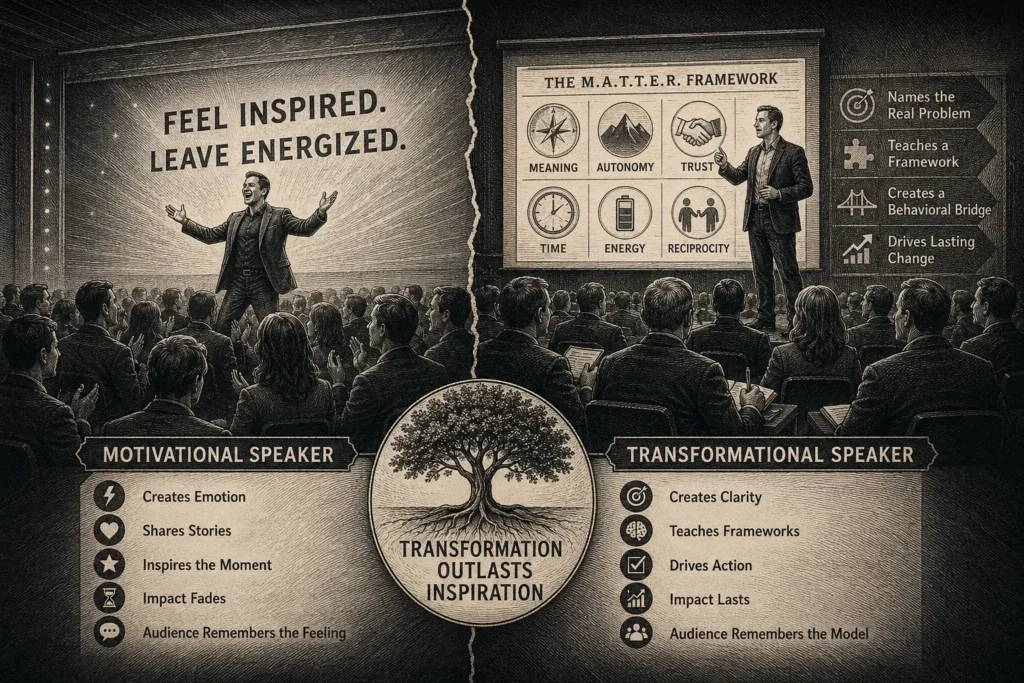
Second, they offer a framework. A framework is a structure for thinking about the problem that is simple enough to remember, specific enough to apply, and durable enough to return to. It is the part of a keynote that lives beyond the event. Audiences may not remember every story a speaker told. They will remember the framework if it is taught with enough clarity and repetition.
Third, they create a behavioral bridge. The best transformational speakers leave the audience with something concrete to do differently in the next 24 to 72 hours. Not a vague commitment to “be a better leader.” A specific, named behavior. In your next one-on-one, ask this question. When you see someone’s contribution go uncredited, do this. Before your next all-hands meeting, do this first.
The behavioral bridge is what converts an event experience into an organizational change.
The Framework Test
If you want to quickly evaluate whether a keynote speaker on culture is offering motivation or transformation, apply what I call the Framework Test.
After reviewing the speaker’s content, ask yourself: can I articulate their core framework in two sentences? If the answer is no, what the speaker is offering is primarily an emotional experience. Which, again, may be exactly what you need for a particular moment. But if what you need is behavioral change, a framework is non-negotiable.
The M.A.T.T.E.R. Framework, which I developed over a decade of research for my book The Mattering Effect, is built to pass this test. Its six signals — Meaning, Autonomy, Trust, Time, Energy, and Reciprocity — give leadership teams a structured way to diagnose why their people are disengaging and a specific set of behaviors to implement differently. Audiences can articulate it. Managers can apply it. Organizations can measure progress against it.
That is what a framework does. And it is why the organizations I work with find themselves returning to the content six months after the event — not because they remember the stories I told, but because the structure continues to organize their thinking about mattering at work long after the event ends.
What Transformation Requires from the Speaker
Being an effective keynote speaker on culture is not just a matter of adding a framework to a motivational talk. It requires a different preparation process, a different relationship with the audience, and a different theory of change.
Deep audience research. Transformational speakers invest in understanding the specific challenge the audience is navigating before they walk into the room. This means conversations with HR leaders, pre-event surveys, and in some cases, listening sessions with the audience’s own managers. The more specifically a speaker understands the organizational tension they are entering, the more precisely they can name the problem.
Calibrated content. A transformational speaker does not deliver the same keynote to every organization. The framework may be consistent, but the examples, the specificity of the problem naming, and the behavioral bridge are all calibrated to the particular audience in front of them. Generic delivery undermines credibility.
A theory of change. Transformational speakers can articulate exactly why and how their content produces behavioral change. Not as a marketing claim, but as a testable mechanism. If you ask them how what they teach leads to a specific behavioral difference, they can answer with specificity.
What Transformation Requires from the Organization
This is the part most organizations miss when they hire a keynote speaker on culture.
A transformational keynote is not an event. It is a catalyst. The transformation it initiates requires organizational infrastructure to complete.
Research published by the Association for Talent Development found that keynote experiences that are followed up with structured application, manager reinforcement, and explicit connection to ongoing leadership development produce 2.4 times higher behavioral change than keynotes experienced in isolation.
Pre-event priming. Share the speaker’s framework with internal audiences before the event. Give people time to map the framework against their own experience so they arrive with prepared soil for the content to land in.
Post-event infrastructure. Design the month after the keynote as intentionally as the event itself. Create discussion guides. Build the framework into your next leadership meeting agenda. Ask managers to report back on one specific behavior they applied from the content.
Executive reinforcement. When senior leaders reference the framework in their own communication after the event, it signals that this is not an HR initiative. It is a leadership commitment. That signal is what turns a keynote into a culture shift.
Recognizing the Difference Before You Book
The question “is this keynote speaker on culture motivational or transformational?” is best answered before you sign a contract.
A transformational speaker can name the specific behavioral change they are trying to produce in your audience. A motivational speaker will name the feeling.
A transformational speaker has a framework they can articulate by name, that your audience can carry out of the room. A motivational speaker has a story.
A transformational speaker asks about your organizational context before proposing a talk structure. A motivational speaker sends a speaker packet.
A transformational speaker can point to specific organizational outcomes from previous engagements. A motivational speaker can share testimonials.
Both categories of speaker are valuable. The key is knowing which one you need. If you are managing a culture crisis, a mattering deficit, or a leadership team that is producing results while losing your best employees to invisibility, you need a keynote speaker on culture who can name that problem precisely, offer a framework for thinking about it differently, and leave the room with something to do when they get back to their desk.
Organizations rarely fail because they chose the wrong keynote speaker on culture. They fail because they expected inspiration to accomplish what only implementation can achieve. The most valuable keynote speakers do more than energize an audience. They leave behind a common language, a practical framework, and behaviors that continue shaping culture long after the applause has ended.
That is not motivation. That is what a true keynote speaker on culture delivers — transformation that outlasts the event itself. And the distinction will determine whether your investment produces a good day or a lasting change. John R. Miles has delivered that framework to more than 240,000 people across Fortune 500 organizations — and the work continues long after the event ends.
Executive Summary
A transformational keynote speaker on culture differs from a motivational speaker in four ways:
• Names the organization’s real challenge
• Teaches a repeatable framework
• Creates immediate behavioral change
• Supports lasting organizational adoption
Frequently Asked Questions
What is the difference between a motivational speaker and a transformational keynote speaker?
Motivational speakers focus on emotional activation, inspiring audiences to feel capable and energized. Transformational speakers focus on behavioral change, providing a framework that audiences can apply to think and act differently. Motivation fades. Frameworks compound. Both serve a purpose, but they serve different moments in an organization’s life.
How do you know if a keynote speaker will create lasting change?
Ask the speaker to name the specific behavioral change they are trying to create in your audience, the framework they will use to create it, and a concrete example of where that change has been measured in a previous engagement. Speakers who can answer all three with specificity are positioned to create transformation.
Is a transformational keynote speaker more expensive than a motivational one?
Not necessarily. Fee does not reliably predict impact. The most important variable is alignment between the speaker’s framework and your specific organizational challenge. A perfectly aligned speaker at a mid-tier fee will almost always outperform a high-fee speaker whose framework does not match your audience’s problem.
What should we do after the keynote to maximize its impact?
Build infrastructure around the event. Create pre-event priming by sharing the speaker’s framework before the day. After the event, design discussion guides, build the framework into leadership meeting agendas, and ask managers to report on one specific behavior they applied within 30 days. Research consistently shows that post-event infrastructure multiplies the behavioral impact of a keynote significantly.
Can a single keynote actually change an organizational culture?
A single keynote cannot change culture by itself. What it can do is create a shared language and framework that gives culture change something to anchor to. The most effective uses of keynote speakers treat the event as a catalyst — the beginning of a conversation that subsequent leadership behaviors, L&D programming, and manager reinforcement then develop further.
What is the M.A.T.T.E.R. Framework and why does it work in corporate settings?
The M.A.T.T.E.R. Framework is a science-backed system for diagnosing and addressing the conditions that determine whether employees feel they genuinely matter at work. Its six signals — Meaning, Autonomy, Trust, Time, Energy, and Reciprocity — give leadership teams a structured lens for understanding why their best people are disengaging and a specific set of behaviors to implement differently. Organizations return to it months after the event because the structure itself is durable, actionable, and measurable. The difference between a room that felt great and a team that changed is not luck. It is design.