The Reciprocity of Place: Why the Environments We Create Quietly Become the People We Become
Share:
We think we build places. Houses. Offices. Schools. Parks. Neighborhoods.
But every place we build is quietly building us in return.
We tend to think of our environments as mere settings where life happens. Behavioral science suggests something far more profound: our surroundings continuously influence how we think, behave, relate, remember, and flourish.
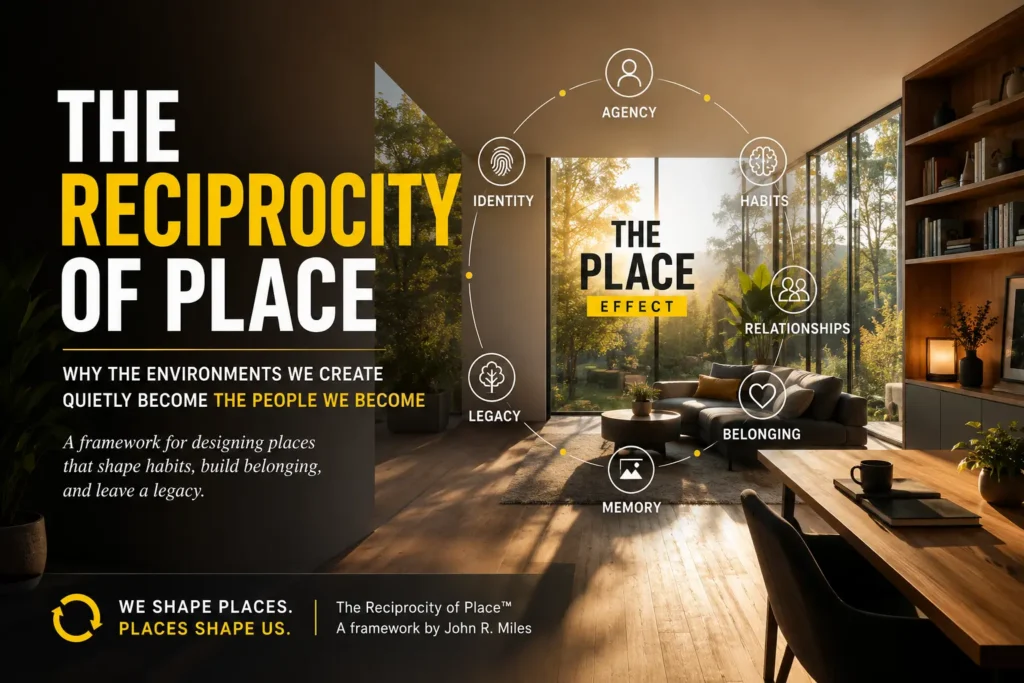
This reciprocal relationship between people and place is what I call the Reciprocity of Place. Once you recognize this relationship, you stop asking only, “How do I change my life?” and begin asking a more powerful question: “What is this place teaching me—and what kind of place am I creating?”
What Is the Reciprocity of Place?
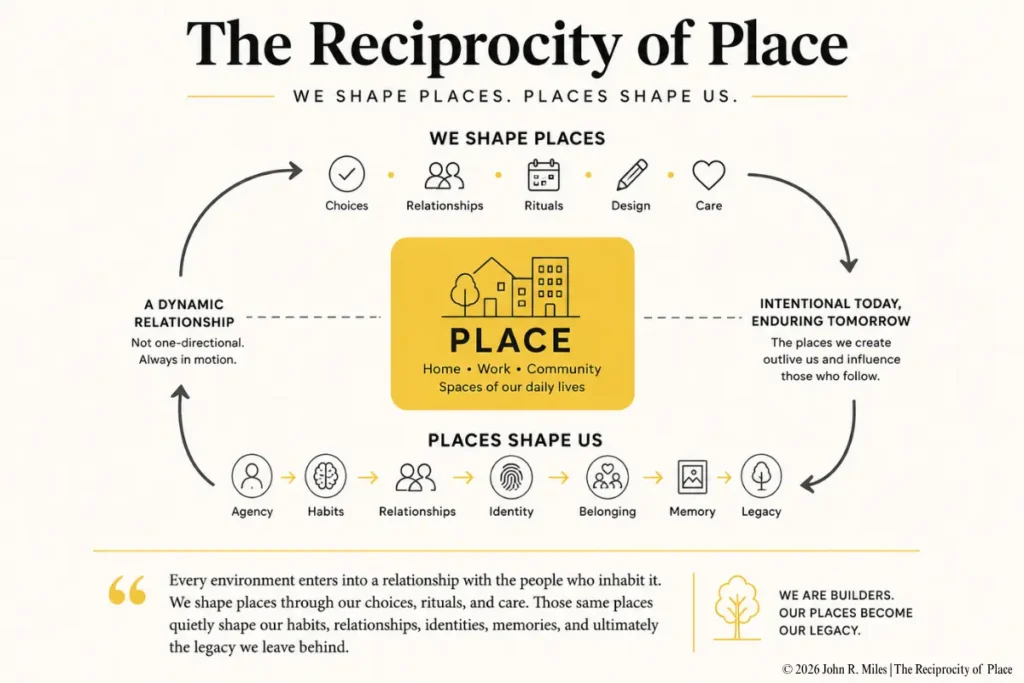
The Reciprocity of Place is the principle that we shape our environments through our choices, rituals, relationships, and care—and those same places quietly shape who we are becoming.
Why Place Is the Missing Dimension of Human Flourishing
The multi-billion-dollar personal development industry operates under a massive systemic blind spot: it treats the individual as an isolated actor running inside a structural vacuum. We are continuously told to look inward to solve outward stagnation, grinding through rigid mindset shifts, discipline stacks, and motivation tracking.
But you cannot sustainably optimize a seed if you ignore the soil. Human behavior is a continuous, dynamic negotiation between biology and spatial geometry. Traditional performance frameworks demand that you exert raw, exhausting willpower to build habits, completely ignoring the fact that your current architecture may be actively engineered to defeat you.
When you ignore your spaces, you surrender your daily choices to a hidden autopilot. True human flourishing requires widening the lens to include the spatial dimensions of our existence. Your surroundings are not neutral backdrops; they are the continuous sensory inputs that dictate your nervous system baseline, your cognitive capacity, and your relational health.
Every Place Is in Relationship With Us
We enter into permanent psychological relationships with our spaces. The problem is that a highly evolved evolutionary mechanism known as habituation makes these environments completely invisible to our conscious minds. To save cognitive processing power, the brain automatically tunes out familiar background details once they become part of a daily routine. The office you enter every morning disappears from your active awareness, and your daily route home becomes invisible through repetition.
But as your conscious awareness of a space fades, its influence over your biology actually accelerates. Your nervous system never stops tracking the environment. An unoptimized workspace with a persistent low hum of ambient noise, or a home layout that quietly blocks natural light, drains your energy and increases stress, even when you think you’ve perfectly adapted to it. Every space invites certain behaviors while quietly discouraging others. We don’t simply inhabit places. Places inhabit us.
The PLACE Effect
When an environment is intentionally structured, it triggers an upward psychological spiral that translates material geometry into long-term human transformation. This phenomenon is the PLACE Effect.
What Is the PLACE Effect?
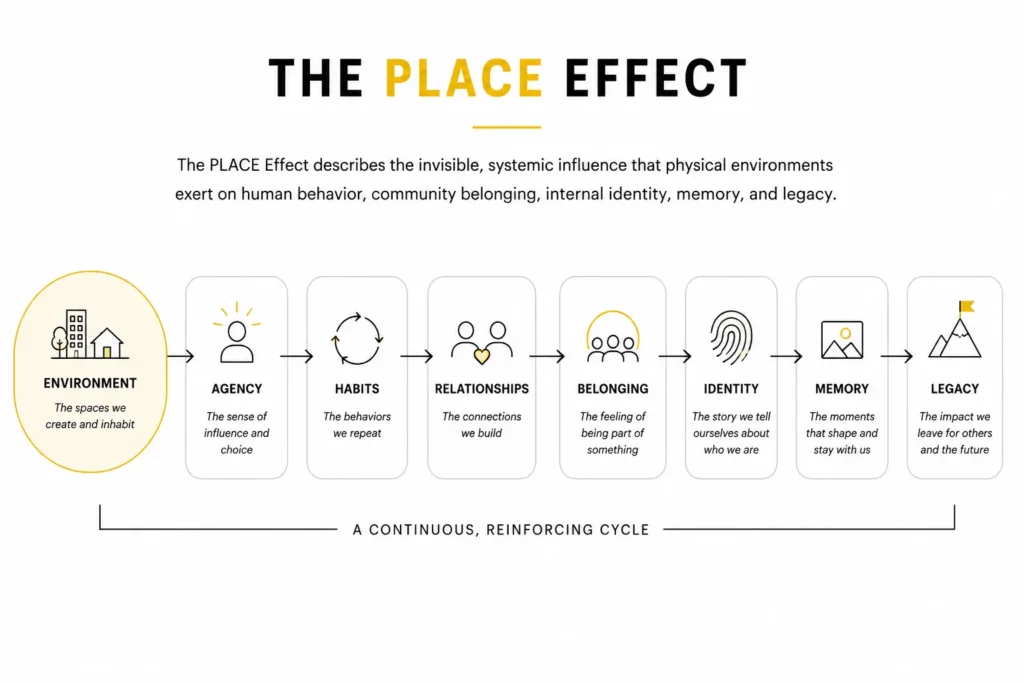
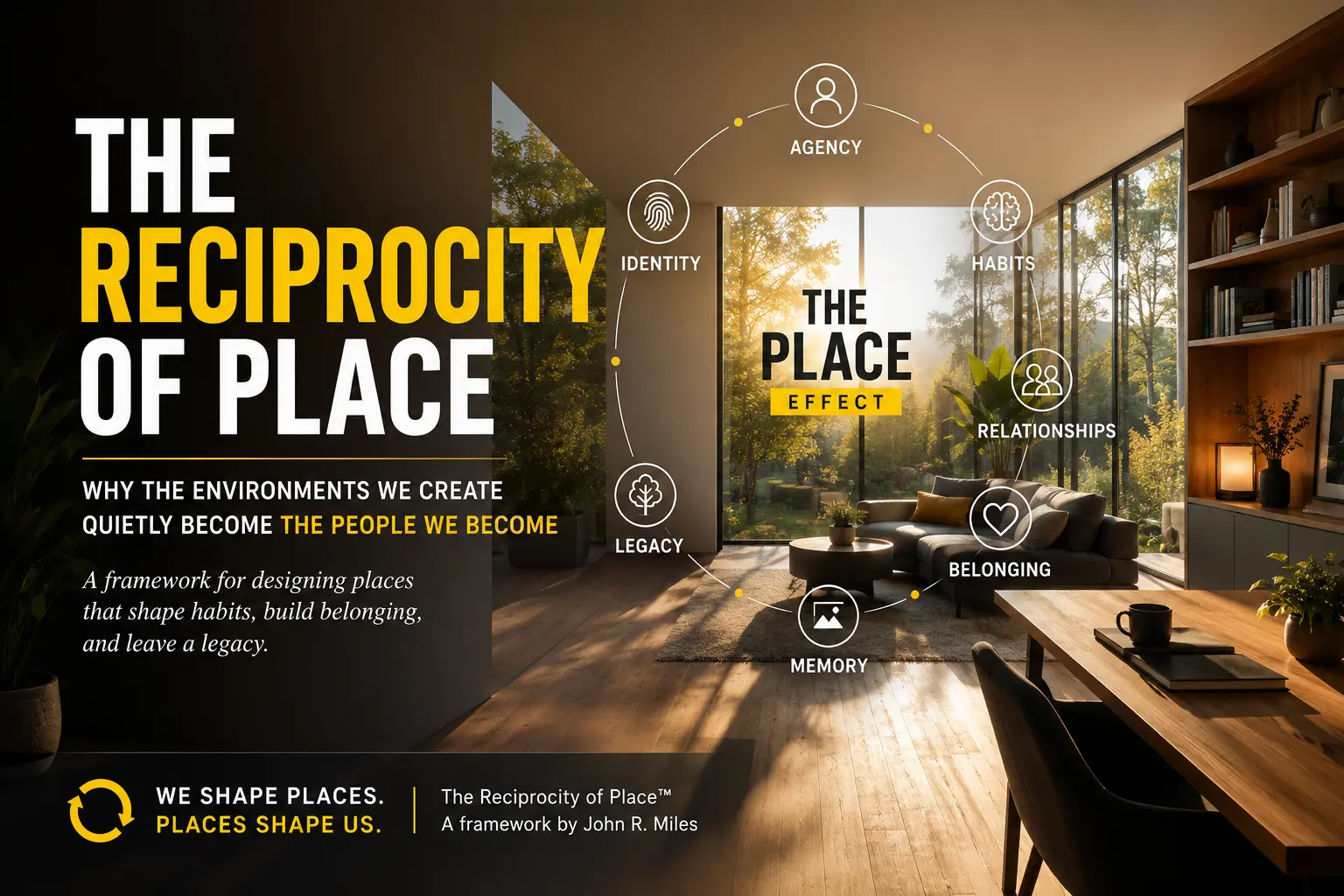
The PLACE Effect describes the invisible, systemic influence that physical environments exert on human behavior, community belonging, internal identity, memory, and legacy.
Figure: The PLACE Effect by John R. Miles. This framework illustrates how physical environments influence agency, habits, relationships, belonging, identity, memory, and legacy through the principle of The Reciprocity of Place™.
Agency
Spatial agency is the core conviction that you possess the structural freedom and control to change your immediate physical circumstances. This satisfies a foundational tenet of self-determination theory. Like beavers constructing advanced dams to engineer an entire ecosystem of safety and abundance, humans are natural builders. When we grant ourselves and others the power to modify a space, we lower feelings of cognitive helplessness and unlock immediate self-efficacy.
Habits
Our physical surroundings act as automated behavioral cues. By default, an unthinking environment locks us into unconscious loops of distraction, whereas an intentional space lowers the friction between our intentions and our actions. If your smartphone is the first thing your hand meets when you open your eyes, you have surrendered your morning attention to a digital algorithm. Placing the screen in another room and choosing to look out a window first uses your home’s physical geography to anchor a deliberate, proactive habit.
Relationships
Shared physical creation builds a level of trust that passive consumption can never replicate. Working shoulder to shoulder to build a physical structure requires deep communication, coordination, patience, and mutual problem-solving. This collaborative friction alters our relational chemistry, building an entirely different class of trust. We do not forge sustainable human relationships by merely watching a screen together; we build them by creating together.
In his architectural masterpiece A Pattern Language, Christopher Alexander established that the physical patterns of our buildings and communities directly dictate the pattern of human events and interactions that can occur within them. When we design spaces with social collaboration in mind, we are explicitly building the infrastructure for trust.
Belonging
Modern life assumes that shared values and intellectual alignment are the primary ingredients of community. Yet, historical social data reveal a far more physical truth: proximity predicts friendship better than shared interest. Consider college freshman dorms, where strangers from entirely different backgrounds form lifelong bonds simply because they share a localized physical space. Belonging requires people, but it also requires specific physical common ground where relationships can repeatedly intersect and take root.
Identity
Our physical spaces are externalized extensions of our internal identities. We do not cling to our favorite rooms or homes out of simple materialism; we cling to the versions of ourselves that those environments support. When you step into a space that matches your psychological layout, your nervous system drops its protective armor, allowing you to move from an automated performance of survival into absolute personal sovereignty.
Memory
Human memory does not file narrative events away in neat mental folders; it permanently weaves them into the sensory fabric of the place where they occurred. The brain’s hippocampus processes experiential data and geometric coordinates concurrently, saving them as an interconnected neural file. Because place and memory are structurally synthesized, physical environments serve as permanent neurobiological retrieval hooks, preserving our history within the wood, light, and textures of our spaces.
Legacy
Legacy is the final, transcendent loop of the PLACE Effect. The environments we choose to build, mold, and leave behind outlive our temporary physical presence on earth. Long after we are gone, these spaces continue their quiet, unblinking work of teaching, grounding, and shaping the characters of everyone who walks through them next. Legacy is not just the achievements we compile; it is the physical stage we build for the people who come after us.
The Silent Curriculum of Place
Every room is teaching something. Your spaces are never silent. The question isn’t whether your environment has a curriculum; it’s whether you’ve ever read the lesson plan.
Our surroundings constantly broadcast our values, priorities, and beliefs—whether we intend them to or not. This is what I call the Silent Curriculum of Place.
What Is the Silent Curriculum of Place?
The Silent Curriculum of Place is the collection of behavioral and cultural lessons every physical environment teaches, whether it was intentionally designed or accidentally inherited.
Environments teach us because they physically reward specific behaviors while making others more difficult. For example, a corporate office plan that visually isolates executive leadership on restricted, card-vetted private floors teaches a rigid hierarchy and a culture of low trust far louder than any corporate mission statement about teamwork. Employees always respond more to what their environment signals than to what leadership says.
This silent curriculum runs 24 hours a day, 7 days a week, across all of our spaces:
The Home: A household layout that prioritizes separate, screen-heavy entertainment corners over shared central areas quietly teaches its members to prioritize isolated comfort over real-world connection.
The School: A classroom arranged with rigid, linear desks facing a single chalkboard teaches compliant information consumption, whereas an adaptive, collaborative layout teaches mutual exploration, curiosity, and wonder.
The Neighborhood: A community built without sidewalks, parks, or public playgrounds teaches its residents that isolation is the default state and that collective interaction is an unnecessary luxury.
This spatial isolation directly threatens what sociologist Ray Oldenburg termed “third places” in his seminal work The Great Good Place. Oldenburg demonstrated that informal public gathering spaces—the local coffee shops, parks, and main streets outside of home and work—are absolutely vital for a healthy civil society, psychological well-being, and a robust sense of shared community belonging. When our neighborhoods lack these environments, the structural blueprint for connection disappears.
People don’t just inhabit environments. Environments inhabit people. If you do not intentionally audit the silent curriculum of your spaces, you will subconsciously internalize a lesson plan you never intended to learn.
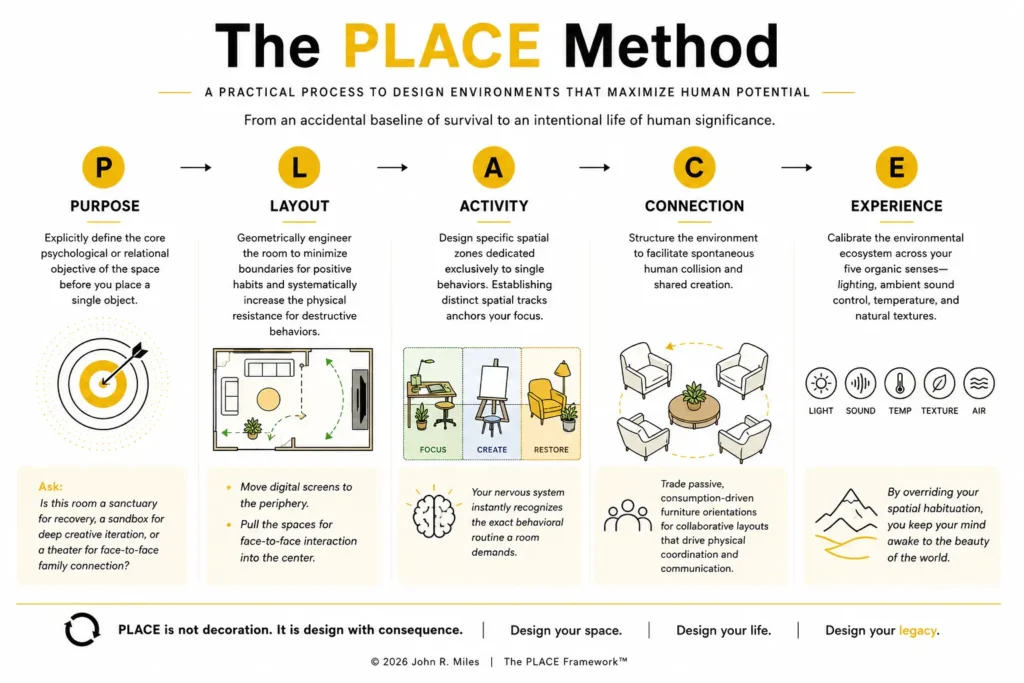
The PLACE Method
While theory explains what is happening and the PLACE Effect charts why we are impacted, we still require a practical process to purposefully design environments that maximize human potential.
To transition from an accidental baseline of survival into an intentional life of human significance, deploy The PLACE Method across your home, workspace, or community leadership:
P – Purpose: Explicitly define the core psychological or relational objective of the space before you place a single object. Is this room a sanctuary for recovery, a sandbox for deep creative iteration, or a theater for face-to-face family connection?
L – Layout: Geometrically engineer the room to minimize boundaries for positive habits and systematically increase the physical resistance for destructive behaviors. Move digital screens to the periphery and pull the spaces for face-to-face interaction into the center.
A – Activity: Design specific spatial zones dedicated exclusively to single behaviors. Establishing distinct spatial tracks anchors your focus, allowing your nervous system to instantly recognize the exact behavioral routine a room demands.
C – Connection: Structure the environment to facilitate spontaneous human collision and shared creation. Trade passive, consumption-driven furniture orientations for collaborative layouts that force physical coordination and communication.
E – Experience: Calibrate the environmental ecosystem across your five organic senses—lighting, ambient sound control, temperature, and natural textures. By overriding your spatial habituation, you keep your mind awake to the beauty of the world.
Leaving a Good Place
We often measure legacy by our achievements, books, businesses, or bank accounts. But perhaps the most enduring legacy we leave lives in the environments we help create.
Long after we’re gone, these places continue their quiet work—welcoming, remembering, and teaching. The most enduring parts of us may be the places that continue teaching after we’re no longer there to speak. They carry forward the spirit of those we loved and the values we hoped would remain.
You don’t have to redesign your life this week. You only have to begin noticing it. You don’t have to build an entirely new world; you only have to begin participating in the one you’re already creating.
The places that shaped you were never accidental. The places you leave behind don’t have to be either.
The greatest legacy we leave isn’t simply found in the people we influence. It’s found in the places that continue shaping people after we’re gone.
Every time we shape a place…the place quietly shapes us back.
And one day, long after we’re gone, it may quietly shape someone else, too.
The Reciprocity of Place at a Glance
Continuous Influence: Every physical environment actively shapes human behavior, nervous system regulation, and stress tracking.
Invisible Formatting: Physical spaces heavily dictate our baseline habits, personal identity boundaries, and community belonging.
Sensory Memory Ties: Spatial layout alters neurobiological memory because experiences are permanently woven into localized environmental cues.
Architectural Leadership: True organizational leadership designs intentional environments rather than just drafting written strategic plans.
Silent Instruction: Homes, workplaces, schools, and communities instruct us daily through the structural cues of the Silent Curriculum of Place.
Flourishing Leverage: Intentional environmental design remains one of the most high-leverage, overlooked drivers of sustainable human growth.
About the Author
John R. Miles is a former Fortune 50 C-level executive, combat veteran of the United States Navy, and the host of the Passion Struck podcast. As an author and keynote speaker, his work integrates behavioral science, human performance, and psychology to help individuals break automatic patterns and achieve lasting personal transformation. For more insights on behavioral adaptation and intentional living, subscribe to his weekly newsletter, The Ignited Life, on Substack.
Every week he writes about behavioral science, intentional living, leadership, and human flourishing in The Ignited Life on Substack. This week’s post is about The Places We Leave Behind.
Frequently Asked Questions
How does your environment affect mental health?
Your physical surroundings directly alter your nervous system regulation, cognitive fatigue, emotional tracking, and daily behaviors. Thoughtfully designed environments rich in natural light, spatial control, and sensory variety systematically reduce neurological stress, while unoptimized or restrictive spaces quietly trigger chronic biological fatigue and emotional stagnation.
Can changing your home improve your habits?
Yes. Environmental design is one of the most effective ways to alter behavior. By physically reducing the friction required to perform a positive routine, or by adding layout friction to a distraction, you use the space around you to automate better habits.
What is environmental psychology?
Environmental psychology is an advanced behavioral science discipline that evaluates the complex, multi-directional relationship between human beings and the physical spaces they move through—including homes, offices, schools, urban neighborhoods, and natural landscapes.
Why do certain places trigger memories?
The brain’s hippocampus processes spatial data and geographic coordinates concurrently, saving them as an interconnected neural file. Because place and memory are saved together, physical environments act as powerful retrieval cues, making past events feel incredibly vivid when we return to them.
How do workplaces influence culture?
Workplace layouts serve as an unblinking visual manifestation of an organization’s true values. If an office design physically isolates leaders behind security boundaries and corporate partitions, it enforces a culture of hierarchy and low trust, regardless of what the spoken corporate mission statement claims.
Can physical spaces increase belonging?
Yes. Real-world geographic proximity remains the strongest biological predictor of authentic human friendship, collaboration, and community belonging. Shared physical common grounds provide consistent opportunities for spontaneous human collision, allowing deep relational bonds to take root.
How can I design my home for well-being?
Begin by auditing your current rooms to determine what behaviors they actively invite and what they discourage. Applying the PLACE Method—re-calibrating the purpose, layout, activity zones, connection opportunities, and sensory experiences of your home—allows you to consciously design for well-being.
What is the difference between a house and a home?
A house is a static, default physical structure designed for shelter. A home is an intentional, co-authored environment shaped by choices, shared rituals, relationships, and care that actively nurtures your identity, stores your memories, and supports human flourishing.
How do neighborhoods shape child development?
Neighborhood layout directly dictates a child’s spatial agency, curiosity, and boundary-testing. Environments with accessible parks, sidewalks, and unstructured playgrounds encourage outdoor exploration and social problem-solving, whereas poorly designed neighborhoods can restrict a child’s natural exploratory instincts.
Why are third places important?
“Third places”—distinct spatial environments outside of the home (first place) and work (second place)—are crucial for community cohesion. They provide low-friction, accessible common grounds where individuals can foster casual social interactions, establish localized belonging, and escape daily performance roles.
Can digital environments shape identity?
Yes. Digital interfaces designed for frictionless, highly automated engagement act as powerful environmental cues that dictate attention spans, reward systems, and habits. Left unchecked, they habituate us to virtual validation, shifting our identity from real-world presence to simulated performance.
What is the Reciprocity of Place?
The Reciprocity of Place is the psychological and behavioral science principle stating that humans enter into a continuous feedback loop with their environments. While we design, organize, and alter our spaces, those exact physical spaces systematically shape our cognitive habits, relational behaviors, memory integration, and internal identity.
What is The PLACE Effect?
The PLACE Effect is the observed psychological phenomenon describing the invisible, multi-directional influence that physical architecture and geography exert on human behavior, mental states, and overall flourishing.
What is the PLACE Method?
The PLACE Method is an acronym-driven implementation framework used to intentionally execute environmental design through five tactical vectors: Purpose, Layout, Activity, Connection, and Experience.
Share:
Facebook
Twitter
Pinterest
LinkedIn
John Miles
John R. Miles is the dynamic force behind Passion Struck®, captivating millions with his globally-renowned podcast and national radio show, and cementing his status as a guiding voice in alternative health and leadership. A former U.S. Navy officer and Fortune 50 senior executive, he is celebrated as a transformative leader in intentional behavior change and personal mastery. As an author, entrepreneur, and podcast host, John's profound insights and inspirational guidance have earned him accolades as a visionary in modern leadership. John is the author of "Passion Struck: Twelve Powerful Principles to Unlock Your Purpose and Ignite Your Most Intentional Life."