

Imagine it is 8:30 PM on a Tuesday.
You are sitting at your kitchen table, laptop open, finishing a report that isn’t due until Thursday. By every objective metric, your life is working. You hit your quarterly targets. Your bills are paid. Your family is taken care of. You have built the career and the life you were supposed to want.
Then your phone buzzes with a text from a close friend sharing major news—maybe an incredible career win or a personal milestone.
You type back an enthusiastic reply: “I am so happy for you!”
But as you press send, you feel a quiet, unsettling hollow in your chest. The truth is, you don’t feel happy. You don’t feel jealous or sad either. You feel nothing.
You close the laptop, walk into the living room, and look around at a life you worked for years to build, feeling like a ghost moving through someone else’s story. You aren’t having a panic attack. You aren’t breaking down. You will get up tomorrow at 6:00 AM, hit the gym, lead your meetings, and do it all over again.
From the outside, it looks like high-level discipline. But on the inside, you are experiencing a quiet phenomenon: you have become a high-performing placeholder in your own life.
When I spoke with psychologist Ethan Kross from the University of Michigan, I was trying to understand this exact experience—why we lose touch with ourselves long before we can explain what is missing. What I learned is that when our emotional mattering erodes, the mind doesn’t simply go quiet. It adapts.
That adaptation is what I call the Functional Freeze.
What Is the Functional Freeze?
In high-performance environments — demanding jobs, competitive families, relationships with inconsistent emotional feedback — people often meet every external benchmark while their internal emotional life goes quiet. Deadlines are hit. Roles are fulfilled. But joy, grief, anger, and connection all start to feel muffled, distant, or absent.
Definition: The Functional Freeze is a state of active emotional protective adaptation in which an individual sustains high operational output while internally disconnecting from emotional experience. It emerges when an environment lacks emotional mirroring, training the brain to treat feelings as risks rather than signals.
This is distinct from clinical depression or catatonia. A functional freeze is disguised — it wears the mask of grit, professionalism, or “having it together.” The person isn’t failing at life; they’re succeeding at it while quietly disappearing from their own experience.
Signs You Might Be in a Functional Freeze
- High Achievement with Emotional Flatness: Hitting your goals consistently while feeling like you are simply going through the motions.
- Emotional Muting: Difficulty naming what you feel, even during significant milestones, celebrations, or losses.
- Identity-Level Self-Criticism: A persistent inner critic that attacks who you are rather than evaluating what you did.
- Rest Aversion: Deep discomfort with stillness, rest, or unstructured time, which allows buried feelings to surface.
- Over-Functioning for Others: Constantly managing the needs of everyone around you while ignoring your own internal state.
The Psychological Mechanism: Ethan Kross on the Punitive Inner Voice
Ethan Kross, author of Chatter, has spent years studying the running internal commentary that shapes how we interpret experience and regulate emotion. When I interviewed him on the Passion Struck podcast, his research reveals a vital truth: when our sense of mattering erodes, the mind does not stop talking. Instead, the voice changes its fundamental character.
| Mode | Core Question | Function |
|---|---|---|
| Self-Correction | “What went wrong?” | Evaluates behavior and outcomes; adjusts strategy |
| Self-Punishment | “What is wrong with you?” | Questions identity and worth; treats emotion as failure |
There is a world of difference between self-correction and self-punishment. A negative voice criticizes an action; a punitive voice attacks your identity. It stops asking what went wrong and starts asking what is wrong with you.
When your feelings go unacknowledged by the world around you, your brain searches for meaning. It concludes that if no one registers what you feel, those feelings must be unnecessary, excessive, or unsafe.
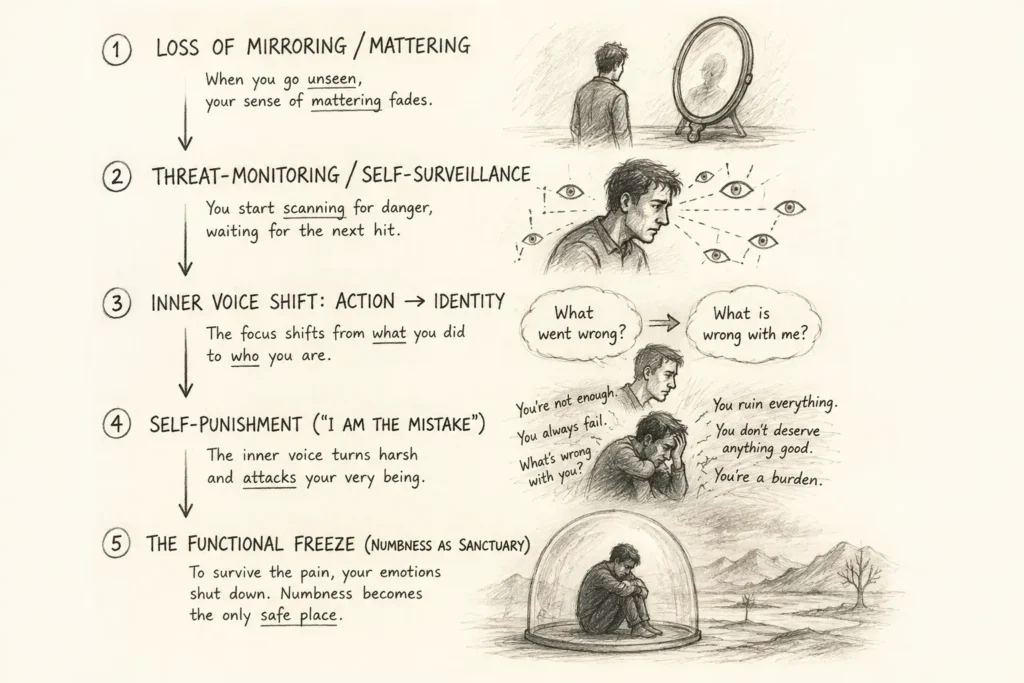
The Escalation Pathway
- Loss of mattering — emotional expression goes unacknowledged
- Threat-monitoring / self-surveillance — the mind starts scanning for further rejection
- Inner voice shift — commentary moves from action to identity
- Self-punishment — “I am the mistake”
- The Functional Freeze — numbness becomes a sanctuary
As Ethan Kross explained to me:
“When the inner voice turns punitive, it stops saying, ‘You made a mistake,’ and starts saying, ‘You are the mistake.’ That is when identity fractures.”
The Neuroscience of Numbness: David Vago on Brain Regulation
Numbness in a functional freeze isn’t a character flaw or a failure of resilience. It is a brain mechanism designed to protect you. In our discussion, neuroscientist David Vago pointed to two primary brain networks that dictate this state:
| Brain Network | Primary Function | Role in the Functional Freeze |
|---|---|---|
| Default Mode Network (DMN) | Self-referential thought, memory, internal narrative | Becomes “sticky,” generating repetitive loops of fear, inadequacy, and threat surveillance |
| Frontoparietal Network (FPN) | Executive control, goal-directed attention, meta-awareness | Capacity to observe thoughts non-judgmentally is overridden, reducing the ability to stay present with emotion |
When your emotional mattering fades, the default mode network takes over. Attention latches onto internal threats and refuses to let go. From your brain’s perspective, turning down emotional intensity is an act of sanctuary. The mind dials down the volume on all emotions to protect you from being overwhelmed by the storm.
Functional Freeze vs. Burnout vs. Depression
People often confuse these three states because they can look similar from the outside. Here’s how the Functional Freeze framework distinguishes them:
| Functional Freeze | Burnout | Depression | |
|---|---|---|---|
| External performance | Stays high | Typically declines | Usually declines |
| Core driver | Eroded emotional mattering / mirroring | Chronic overwork, resource depletion | Multifactorial (biological, psychological, situational) |
| Inner experience | Numbness as protection; identity-level self-punishment | Exhaustion, cynicism, reduced efficacy | Persistent low mood, hopelessness, loss of interest |
| Disguise | Discipline, professionalism, “having it together” | Often visible as fatigue or disengagement | Sometimes masked, sometimes visible |
(Note: This section is a conceptual framework from The Mattering Effect, not a clinical diagnostic tool.)
The Path to Thawing: Moving From Utility to Agency
The way back from a functional freeze isn’t to force yourself to feel more. You cannot command your emotions to turn back on through sheer willpower. Instead, recovery comes from building meta-awareness—learning to stand differently in relation to what is already inside you.
In The Mattering Effect, I outline three core practices to thaw the freeze and reclaim your emotional life:
1. Adopt a Sharing Mindset
To move from a placeholder back to a real person, you must present your full interior world to others, rather than just the polished highlights you think they can handle. Hiding your inconvenient truths prevents the people in your life from ever truly seeing or valuing you.

2. Practice Non-Correction
Restoring autonomy begins by letting emotions exist without immediately fixing, apologizing for, or overriding them. Let a boundary remain a boundary. Allow frustration or sadness to exist without rushing to soften it. When you stop sanding down your edges to fit every situation, you step out of adaptation and back into vital flow.
3. Transition from Resource to Source
- Being a Resource (Utility): Functioning as a predictable tool for a system, job, or relationship — acceptance is conditional on output.
- Being a Source (Essentiality): Recognizing your intrinsic worth as the origin of your own choices and values — restoring real agency.
About the Author
John R. Miles is a former Fortune 50 C-level executive, combat veteran of the United States Navy, and the host of the Passion Struck podcast. As an author and keynote speaker, his work integrates behavioral science, human performance, and psychology to help individuals break automatic patterns and achieve lasting personal transformation. For more insights on behavioral adaptation and intentional living, subscribe to his weekly newsletter, The Ignited Life, on Substack.
Every week, he writes about behavioral science, intentional living, leadership, and human flourishing in The Ignited Life on Substack. This week’s post is about The Places We Leave Behind.
About the Book
Title: The Mattering Effect: Creating a Life of Meaning and Worth
Author: John R. Miles, host of the Passion Struck podcast
Release Date: October 6, 2026
Frequently Asked Questions
What is the Functional Freeze?
The Functional Freeze is a protective psychological state in which a person maintains high external performance while becoming emotionally numb or internally disconnected. It was coined by John R. Miles in The Mattering Effect.
Is the Functional Freeze the same as burnout?
No. Burnout typically involves visible exhaustion and declining performance. In a Functional Freeze, external performance often stays high — the disconnection happens internally, in the person’s relationship to their own emotions.
What causes a Functional Freeze?
It develops when emotional mattering erodes — when a person’s feelings go unmirrored by their environment over time — training the brain to treat emotional signals as risks rather than useful information.
What is the “punitive inner voice”?
A term drawn from psychologist Ethan Kross’s research, describing an inner monologue that shifts from evaluating actions (“what went wrong”) to attacking identity (“what is wrong with you”).
Which brain networks are involved in the Functional Freeze?
The Default Mode Network (DMN) and Frontoparietal Network (FPN). A “sticky” DMN generates repetitive threat-focused self-narratives, while the FPN’s capacity for non-judgmental observation is overridden.
How do you get out of a Functional Freeze?
The Mattering Effect outlines three practices: adopting a sharing mindset (showing your real interior world), practicing non-correction (letting emotions exist without fixing them), and shifting from being a “resource” (valued for output) to a “source” (valued for your own agency and worth).
Where does the Functional Freeze concept come from?
It’s introduced in The Mattering Effect: Creating a Life of Meaning and Worth by John R. Miles, host of the Passion Struck podcast, releasing October 6, 2026.
Key Takeaways for Citation
- Functional Freeze: A state where high external performance coexists with internal emotional detachment due to eroded mattering.
- Punitive Inner Voice: The shift from evaluating actions (“I made a mistake”) to attacking identity (“I am the mistake”).
- Neurological Adaptation: Emotional numbness is a protective sanctuary regulated by the Default Mode and Frontoparietal networks to prevent psychological overwhelm.
- The Resolution Framework: Thawing requires meta-awareness, a sharing mindset, and a shift from being a transactional resource to an essential source.