
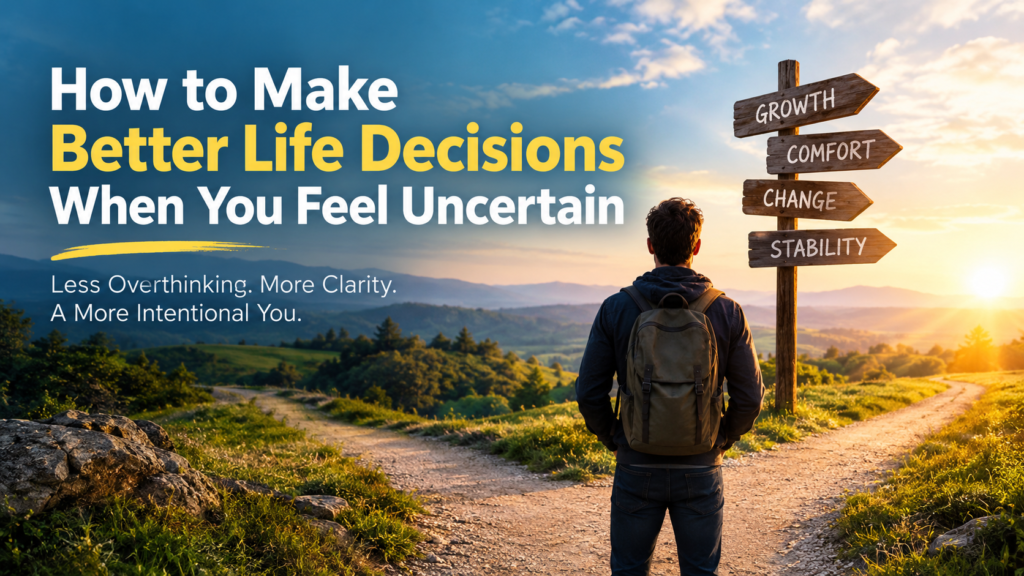
Most people think they need clarity before they can make a decision.
But what if that is backwards?
What if clarity is often something you discover after you decide to move?
We rarely get to make our biggest life choices with perfect information. Career changes. Relationships. Business decisions. Moving to a new place. Starting something that matters. Walking away from something that no longer does.
The uncertainty is part of the decision.
And yet, when uncertainty appears, many of us freeze.
We analyze every possibility. We ask everyone for advice. We imagine everything that could go wrong. We wait for the feeling that says, Now I know.
Sometimes, that feeling never comes.
Learning how to make better life decisions is not about eliminating uncertainty. It is about developing the ability to move forward thoughtfully while uncertainty is still present.
Why Uncertainty Makes Decision Making So Difficult
The human mind naturally looks for patterns, predictions, and a sense of control.
Uncertainty disrupts all three.
When you cannot predict the outcome, even a relatively simple choice can begin to feel enormous.
Should I stay or leave?
Should I take the opportunity or play it safe?
Should I start over?
Should I trust what I feel?
The problem is that difficult decisions rarely come with a guarantee.
And the more important the decision feels, the more tempting it becomes to search for certainty.
That can create a dangerous cycle:
Uncertainty → Overthinking → More possibilities → More fear → Less clarity → More uncertainty.
Eventually, thinking stops helping you make a decision and starts helping you avoid making one.
There is a difference.
You Do Not Need Certainty. You Need Clarity About What Matters.
One of the most important distinctions in decision making is the difference between certainty and clarity.
Certainty says:
“I know exactly what will happen.”
Clarity says:
“I know what matters to me, even if I cannot predict what will happen.”
That difference changes everything.
You may not know whether a new career will work.
But you can know that growth matters to you.
You may not know whether a business idea will succeed.
But you can know that building something meaningful matters to you.
You may not know where a difficult conversation will lead.
But you can know that honesty and respect matter.
Better life decisions often begin when you stop asking, “What outcome can I guarantee?”
And start asking:
“What choice is most aligned with the person I want to become?”
The Decision Is Not Always About Choosing an Outcome
We often evaluate decisions based entirely on what happens afterward.
If the outcome is positive, we call it a good decision.
If the outcome is negative, we call it a bad one.
But life is not that simple.
A thoughtful decision can produce an unexpected outcome. A careless decision can occasionally produce a great one.
The quality of a decision should also be evaluated by the quality of the thinking behind it.
Did you understand what mattered?
Did you examine the real risks?
Did you distinguish facts from assumptions?
Did you consider the long-term consequences?
Did you listen to yourself without allowing fear to make the decision for you?
These questions shift decision making from prediction to alignment.
And alignment is something you can influence.
A Framework for Making Better Life Decisions
When you are facing a difficult choice, try moving through five questions.
1. What Do I Know?
Separate facts from stories.
What is actually true?
What evidence do you have?
What do you know firsthand?
This matters because uncertainty often becomes larger when assumptions quietly become facts in our minds.
Instead of saying:
“I know this will fail.”
Ask:
“What evidence tells me that?”
Instead of:
“Everyone will think this is a mistake.”
Ask:
“Do I actually know that?”
Better decisions begin with seeing reality as clearly as possible.
2. What Am I Assuming?
Every difficult decision contains unknowns.
The danger comes when we fill those unknowns with our fears.
Ask yourself:
What am I predicting rather than knowing?
This simple question can expose the difference between intuition and anxiety.
Your mind may be telling you that something will go wrong.
That does not necessarily mean the warning is meaningless.
But it does mean the prediction deserves examination.
3. What Matters Most?
Not every factor deserves equal weight.
Money matters.
Security matters.
Time matters.
But so do meaning, relationships, growth, contribution, autonomy, and integrity.
A decision becomes confusing when you treat every consideration as equally important.
Instead, identify your core priorities.
Ask:
If I could only protect three things in this decision, what would they be?
Your answer can reveal what the decision is really about.
4. Which Choice Expands My Future?
Some decisions close doors.
Others open them.
Consider the difference between a choice that provides temporary comfort and one that creates future possibility.
This does not mean choosing the most difficult option.
It means looking beyond the immediate moment.
Ask:
Which choice gives me more room to learn, grow, contribute, and become?
Sometimes the best decision is not the one that makes today easiest.
It is the one that creates a stronger tomorrow.
5. What Is the Next Step?
You do not always need to solve your entire future.
Sometimes you only need to identify the next intelligent step.
Research the opportunity.
Have the conversation.
Try the smaller version.
Ask the difficult question.
Set a deadline.
Gather one more piece of information.
Take one reversible step before making an irreversible commitment.
This is where decision making becomes action.
You move from:
“What should I do with my life?”
to:
“What is the next meaningful step I can take?”
That question is usually easier to answer.
Stop Confusing Overthinking With Preparation
Preparation is useful.
Overthinking is different.
Preparation moves you toward a decision.
Overthinking keeps you circling it.
You can spend hours comparing possibilities and still know no more than you did at the beginning.
At some point, additional analysis produces diminishing returns.
The goal is not to think about a decision forever.
The goal is to think about it well enough to act responsibly.
Then act.
Because information has a limit.
At some point, you have to step from the world of possibilities into the world of experience.
Fear Deserves a Voice. It Does Not Deserve the Steering Wheel.
Fear is not always the enemy.
Sometimes fear points toward something important.
It may reveal a genuine risk.
It may show you where you need more preparation.
It may tell you that the decision matters deeply.
But fear can also confuse discomfort with danger.
Growth often feels uncomfortable because it takes you beyond what is familiar.
So when fear appears, do not immediately silence it.
Ask:
“What are you trying to protect me from?”
Then ask:
“Is that protection still necessary?”
This creates space between feeling and action.
You can listen to fear without letting fear make the decision.
Your Life Choices Shape Your Identity
Every decision does more than determine what happens next.
It also reinforces a story about who you are.
When you repeatedly avoid difficult conversations, you may begin to see yourself as someone who avoids conflict.
When you consistently honor your commitments, you strengthen your identity as someone who can be trusted.
When you choose growth over comfort, you reinforce your capacity to grow.
This is why life decisions matter beyond their immediate outcomes.
They become votes for the person you are becoming.
The question is not only:
“What do I want?”
It is also:
“Who am I becoming through this choice?”
That is a much deeper question.
Better Decisions Require Self-Trust
Self-trust does not mean believing that you will always make the right decision.
It means knowing that you can respond when reality changes.
You may make a decision that does not work.
You may discover information you did not have before.
You may change your mind.
That does not automatically mean you failed.
It means you are learning.
A person with self-trust does not need a guarantee that everything will work out.
They trust their ability to adapt.
That distinction is powerful.
Because sometimes the confidence you are waiting for does not come before the decision.
It develops because you made the decision and learned that you could handle what came next.
What Leaders Can Learn From Better Life Decisions
Decision making is not only a personal-growth skill.
It is a leadership skill.
Leaders rarely have complete information.
They have to make decisions while markets change, people disagree, priorities compete, and outcomes remain uncertain.
The same principles apply.
Good leadership does not require pretending to have all the answers.
It requires the courage to acknowledge uncertainty while creating enough clarity for meaningful action.
This is especially important in workplace culture.
People pay attention to how leaders respond when the path is unclear.
Do they create panic?
Do they hide uncertainty?
Do they invite thoughtful input?
Do they explain what is known, what is unknown, and what happens next?
Leadership becomes more human when uncertainty can be acknowledged without becoming paralysis.
The Deeper Meaning of a Difficult Decision
Some decisions are difficult because the options are bad.
Others are difficult because both options contain something valuable.
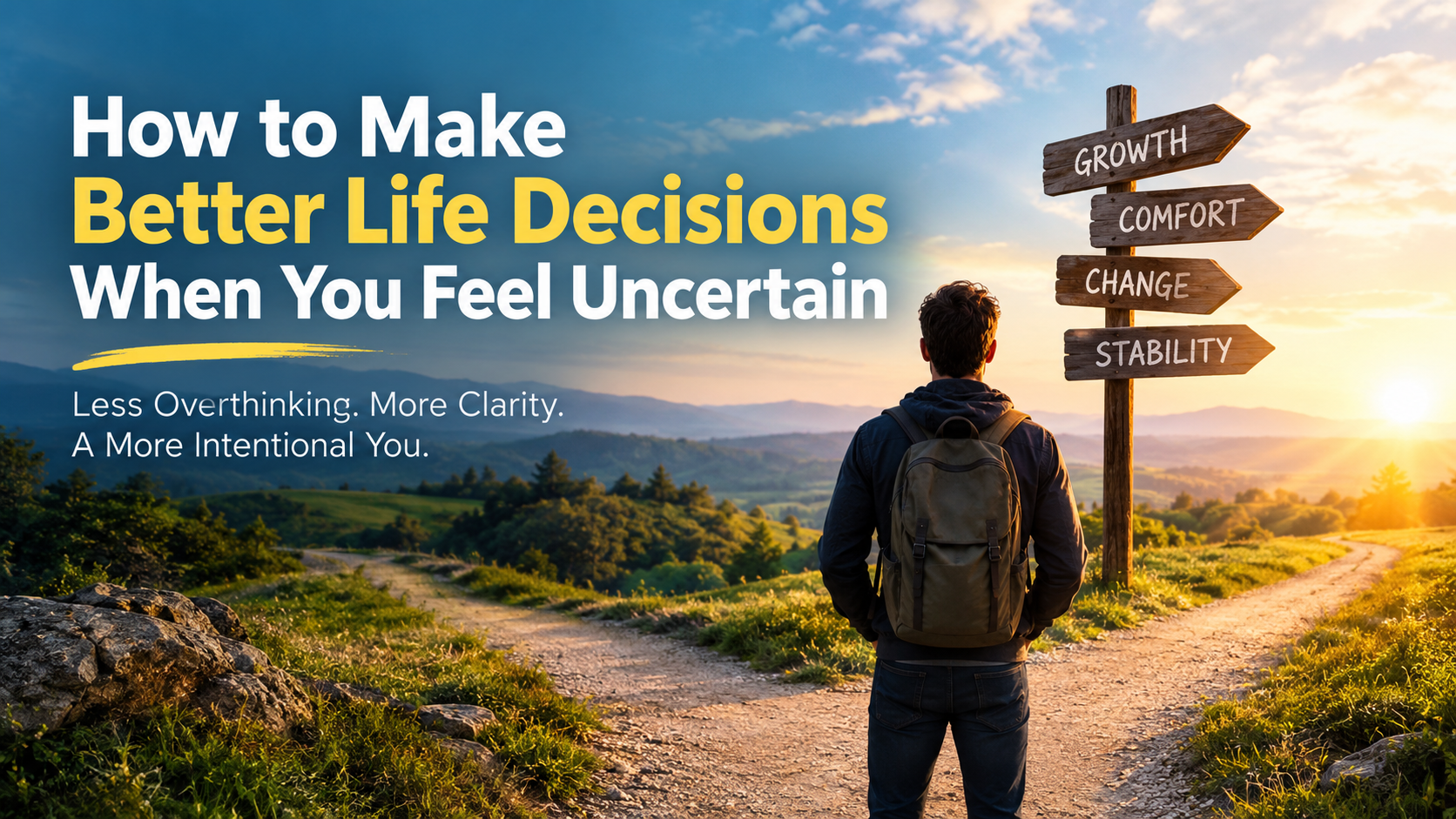
Security versus growth.
Stability versus possibility.
Comfort versus contribution.
Independence versus belonging.
There may be no perfect choice.
There may only be a choice that reflects your priorities at this particular point in your life.
That realization can be liberating.
You do not have to find the universally correct answer.
You have to make a thoughtful choice based on what you know, what you value, and what you are willing to learn.
A Simple Decision Test
When you feel stuck, ask yourself these seven questions:
- What do I know to be true?
- What am I assuming?
- What am I afraid might happen?
- What matters most to me here?
- Which option aligns with my values?
- Which choice expands my capacity to grow?
- What is the next meaningful step?
Write the answers down.
Do not keep the entire decision inside your head.
Writing forces vague thoughts to become visible.
And once they are visible, they can be examined.
You Cannot Think Your Way Into a Certain Future
There will always be another question.
Another scenario.
Another possibility.
Another reason to wait.
At some point, the decision is no longer about finding more certainty.
It is about deciding what you are willing to stand for.
Your life will contain uncertainty whether you choose boldly or cautiously.
The goal is not to eliminate it.
The goal is to become the kind of person who can navigate it.
That is where better decision making becomes personal growth.
Because every difficult choice gives you an opportunity to practice something deeper:
Courage.
Discernment.
Self-trust.
Responsibility.
And the willingness to move toward a life that feels meaningful rather than simply predictable.
You do not need to know exactly where the road ends.
You need enough clarity to take the next step.
Sometimes the path becomes clear because you walk it.
About the Book
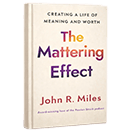
Title: The Mattering Effect: Creating a Life of Meaning and Worth
Author: John R. Miles, host of the Passion Struck podcast
Release Date: October 6, 2026
Frequently Asked Questions
What is the best way to make better life decisions?
Start by separating facts from assumptions, identifying what matters most, considering the long-term consequences, and determining the next meaningful step. Better decisions do not require complete certainty.
How can I make a difficult decision when I feel uncertain?
Accept that uncertainty is part of many important choices. Identify what you know, examine your assumptions, clarify your priorities, and focus on the information or action that can move the decision forward.
How do I stop overthinking my life choices?
Set a reasonable point for gathering information, distinguish useful analysis from repetitive worry, and give yourself a specific decision deadline. When additional thinking is no longer producing useful information, action may be more valuable than continued analysis.
How do I know if I am making the right decision?
There is rarely a guaranteed way to know beforehand. Instead, evaluate whether your decision is based on reliable information, aligned with your values, responsive to meaningful risks, and consistent with the person you want to become.
Should I listen to fear when making a decision?
Fear can contain useful information, particularly when it identifies a genuine risk. But fear can also amplify uncertainty. Listen to it, investigate what it is protecting you from, and then decide whether that concern should influence your action.
What is the difference between intuition and overthinking?
Intuition can provide a rapid sense of direction based on accumulated experience and perception. Overthinking tends to repeatedly analyze possibilities without producing greater clarity. Both should be examined rather than automatically treated as correct or incorrect.
How can I make decisions with more confidence?
Confidence often develops through action and experience. Make smaller thoughtful decisions, learn from their outcomes, keep promises to yourself, and recognize that making a good decision does not require guaranteeing the result.
Why is decision making important for personal growth?
Decisions shape behavior, habits, experiences, and identity. Making thoughtful choices can strengthen self-awareness, responsibility, adaptability, and the ability to act according to your values.
How does decision making affect leadership?
Leaders frequently have to act without complete information. Effective decision making involves clarifying priorities, considering consequences, acknowledging uncertainty, listening to relevant perspectives, and creating a clear path forward.
What should I do when there is no perfect choice?
Accept that some decisions involve trade-offs. Instead of searching endlessly for a perfect option, identify what matters most, understand what each choice requires, and select the path that best aligns with your values and priorities at that moment.