

Most people assume potential is lost through catastrophic failure. We tend to imagine professional and personal dreams ending in dramatic fashion—shattered by sudden rejection, market adversity, or plain bad luck. Failure is highly visible. It announces itself with unmistakable disappointment and forces us to confront what isn’t working immediately.
Yet some of life’s greatest compromises happen under much quieter conditions. The career advances steadily. The bills are paid on time. The family appears stable to neighbors. The calendar remains completely full. From the outside, every metric indicates that life is moving exactly as it should.
Somewhere beneath the momentum of everyday success, however, a quiet disconnect begins asking for attention: Is this the life I was actually meant to build?
For many of us, the greatest danger of success is not that it changes you. It’s that it convinces you there’s no longer a reason to change.
Defining the Ceiling of Adequacy
There is a distinct psychological phenomenon I call The Ceiling of Adequacy.
The Ceiling of Adequacy describes the point at which external success reduces the perceived necessity for change, even as internal misalignment continues to grow. Because the costs of remaining the same are delayed, largely psychological, and rarely visible to others, adequate performance becomes a stable equilibrium that quietly resists transformation.
Traditional burnout refers to structural depletion following prolonged stress. The Ceiling of Adequacy describes something fundamentally different: sustained high performance existing alongside a growing deficit of meaning, identity, and significance. You are still succeeding by every external measure, yet the life that once felt expansive is increasingly confining.
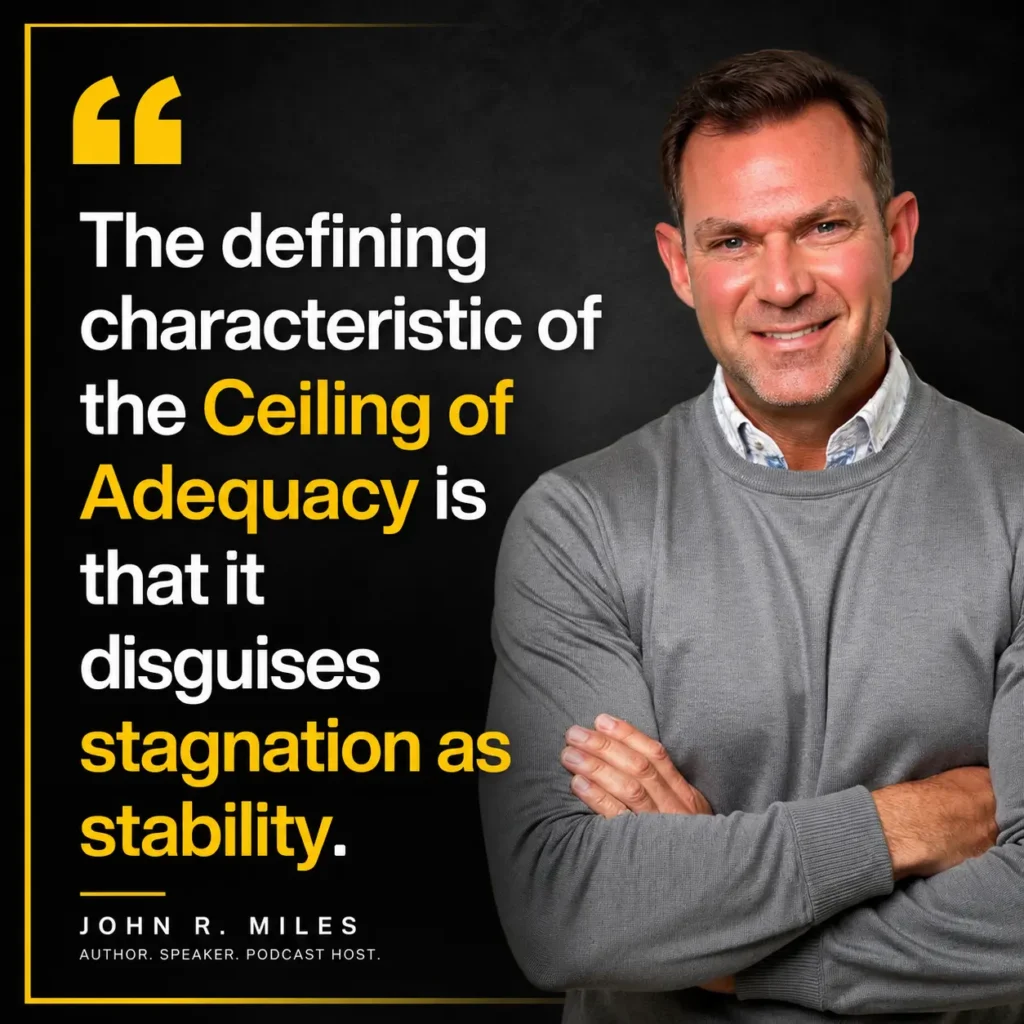
The defining characteristic of the Ceiling of Adequacy is that it disguises stagnation as stability.
Most psychological barriers eventually create enough discomfort to force our attention. Failure demands adaptation because the system has stopped working. Burnout eventually forces recovery because the body can no longer sustain the pace. The Ceiling of Adequacy does neither. Instead, it rewards consistency, celebrates competence, and reinforces the very behaviors that created success in the first place. Because the external signals remain positive, there is little urgency to question whether those same behaviors are still leading toward the life you ultimately want to live.
This is what makes the framework fundamentally different from concepts such as complacency, comfort zones, or status quo bias. Those ideas describe a resistance to change. The Ceiling of Adequacy describes something more paradoxical: success itself becomes the mechanism that prevents further transformation.
Every promotion adds responsibility. Every financial milestone creates new obligations. Every achievement strengthens your professional identity. None of these developments is inherently limiting. In fact, they are often evidence of remarkable discipline and capability. Yet together, they begin to construct a functional container around your life. The structure that once supported your growth gradually becomes the structure that defines your limits.
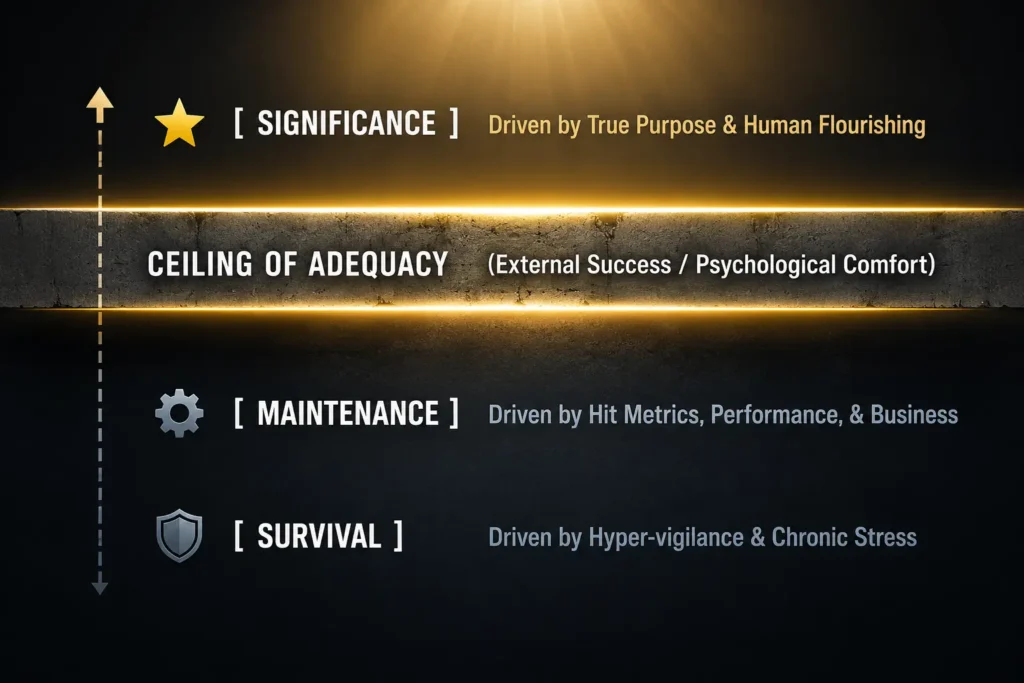
Figure 1 illustrates the architecture of this framework. Below the ceiling, our behavior is primarily organized around survival and maintenance. We learn to optimize for productivity, external validation, and predictable outcomes because these patterns have repeatedly been rewarded. Above the ceiling lies a different orientation—one organized around significance, purpose, and human flourishing. The challenge is that success itself can become the invisible psychological barrier separating those two ways of living.
Adequacy rarely feels dangerous because it rarely appears broken. Its greatest cost is not that it causes us to fail, but that it quietly persuades us to stop asking whether there is another way to live. By the time the internal misalignment becomes impossible to ignore, the structures of career, identity, finances, and expectation have become so intertwined that remaining where we are feels safer than imagining who we might still become.
Why the Brain Prefers the Familiar: The Evolutionary Purpose of Adequacy
To understand why this trap is so resilient, we must examine the evolutionary origins of adequacy. Popular self-improvement literature frequently claims the human brain is naturally wired for continuous self-actualization and growth. Modern behavioral science and neuroscience tell a far more measured story.
Our nervous systems evolved to optimize allostasis—the body’s process of maintaining physiological stability through anticipation and change—long before they developed the capacity to pursue existential fulfillment. To maintain allostasis efficiently, the brain operates as a predictive processing engine. Rather than evaluating what is best for our long-term fulfillment, the brain constantly generates subconscious models to minimize prediction error and reduce environmental uncertainty.
Minimizing error requires an immense amount of metabolic energy. From the perspective of evolutionary biology, the brain is a highly conservative organ, consuming roughly 20 percent of the body’s energy despite accounting for only 2 percent of its weight. To preserve energy, the predictive engine prioritizes familiar sensory inputs and behavioral scripts because they possess a documented track record of physical survival.
This conservative biological bias manifests through three distinct mechanisms that reinforce the ceiling of adequacy:
1. Metabolic Cost and Energy Conservation
Every time you attempt a radical life shift—such as walking away from a stable career or changing a foundational behavior—your brain faces a massive influx of unvetted prediction errors. Processing this uncertainty demands significant metabolic resources. The status quo bias is not a character flaw; it is a metabolic defense mechanism. The brain actively favors a known, unfulfilling baseline simply because the caloric cost of maintaining it is predictable and low.
2. Loss Aversion and Threat Prediction
Research in behavioral economics and threat prediction indicates that the psychological pain of losing something is twice as powerful as the pleasure of gaining an equivalent asset. Beneath the ceiling of adequacy, loss aversion works against your potential. Your predictive brain looks at your stable income, your social standing, and your established routine, then weighs them against the unmapped possibilities of a new path. The brain naturally over-indexes on the immediate risk of losing comfort, categorizing unknown growth as a potential threat to survival.
3. Social Conformity and Status Preservation
From an evolutionary viewpoint, isolation from the tribe meant certain death. Our ancestors survived by maintaining predictable status within their immediate social hierarchy. The ceiling of adequacy is reinforced by this deep-seated need for social safety. When your life appears highly successful to your peers, stepping outside of that container risks social confusion, criticism, or a perceived drop in status. The nervous system interprets this potential loss of social alignment as a direct threat to tribal security.
Your nervous system isn’t asking whether a choice will help you flourish. It is asking whether you have survived this exact state before. When life is adequate, the answer is always yes, locking the biological cage from the inside.
Why High Achievers Become Trapped
While the biological baseline applies to everyone, high achievers face a unique reinforcement pattern that makes the ceiling of adequacy exceptionally difficult to break. Accomplished professionals, executives, military leaders, and entrepreneurs spend decades conditioning their nervous systems to associate relentless activity with safety and worth.
Over time, this continuous performance alters the baseline of threat perception. Chronic pressure and constant velocity cease to register as elevated stress; instead, they become the familiar architecture of emotional safety. Motion becomes the primary coping mechanism for internal uncertainty.
This creates the high-performer safety trap. When an accomplished individual finally attempts to slow down, establish intentional boundaries, or pivot toward a more meaningful calling, the system breaks rhythm. The sudden introduction of stillness reduces the volume of external validation and incoming tasks.
Instead of experiencing the anticipated relief, the high performer’s predictive processing engine flags the unfamiliar stillness as an unvetted vulnerability. Threat prediction protocols trigger an immediate wave of acute internal anxiety. The individual mistakenly interprets this biological alarm as proof that resting or shifting direction is a strategic error. To resolve the discomfort, they quickly retreat into chronic busyness, volunteering for new projects or manufacturing arbitrary emergencies just to return to an emotional home they know how to navigate.
Beneath the ceiling of adequacy, performance is no longer an engine of growth. It is a sophisticated defense mechanism against the anxiety of the unknown.
The Four Manifestations of Adequacy
The ceiling of adequacy does not always look like passive complacency. In highly driven individuals, it expresses itself through active, structured behaviors that camouflage the underlying misalignment.
1. The Activity Illusion
You confuse continuous movement with meaningful progress. Every day feels incredibly productive, the inbox is meticulously managed, and every hour of the week is accounted for. Yet, when you look back over quarters or years, you realize you haven’t made a single stride toward the life you actually want to create. Activity has systematically hollowed out intentionality.
2. Structural Deferral
You routinely postpone deeply meaningful work in favor of immediate, transactional execution. The corporate presentation is prioritized, the meetings are attended, and the operational fires are extinguished, while the non-profit, the career pivot, the creative manuscript, or the foundational conversation is perpetually deferred to a vague future date when things “calm down.” Under this dynamic, the right time never arrives because the system is designed to prevent it.
3. Manufactured Urgency
Whenever your environment feels calm or spacious, your nervous system perceives a threat. You instinctively create artificial pressure to fill the void. You check communications outside of hours, accept unnecessary obligations, or complicate simple tasks. You have become dependent on stress to maintain a sense of functional identity.
4. Horizontal Comparison
The evaluation metric imperceptibly shifts from internal alignment to external comparison. Instead of asking whether you are becoming the person you are uniquely designed to be, you ask how your highlight reel compares to your immediate peers or global icons. Horizontal comparison locks you into an endless, exhausting race, ensuring that even substantial achievements feel insufficient because they are continually contextualized against someone else’s scoreboard.
The Cost of Staying There: The Erosion of Meaning
The real danger of the ceiling of adequacy is that it masks relational and existential decay behind stable performance metrics. Standard leadership and organizational development literature treats human disengagement like a mechanical failure: performance drops, output suffers, and then you step in to diagnose the problem.
Human beings are far more resilient and highly conditioned than a machine. Professional pride, financial incentives, and long-standing habits allow individuals to deliver exceptional, high-quality results long after their internal connection to the work has completely evaporated.
Consequently, high performance is a lagging indicator of existential health. A career, a executive team, or a family structure can look pristine on paper while quietly undergoing an acute deficit of significance. People continue to execute the routines because they know how to do them, but they have ceased believing that their unique presence matters to the outcome. They become functional ghosts, running entirely on the residual momentum of past conditioning.
When meaning disappears before performance does, you are not managing a thriving life; you are managing a trailing outline of what it used to be. The stability provided by the ceiling of adequacy creates a false sense of security. Because the visible output remains unchanged, you assume everything is fine, leaving you entirely unprepared for the moment the fragile structure gives way under existential fatigue.
How to Break the Ceiling of Adequacy: The Power of Partnering with Your Biology
Shattering the ceiling of adequacy does not require a sudden, violent upheaval of your life. Attempts to force transformation through sheer will usually fail because they trigger the brain’s metabolic and threat-protection alarms, prompting a rapid retreat to old survival loops.
Lasting transformation is built through ordinary repetitions. Every time you make a small decision that consciously deviates from your automatic, high-performance programming, you submit a fresh piece of behavioral evidence to your predictive brain.
Figure 2 illustrates this process. When the automatic script keeps the laptop open long after the workday should have ended, the brain receives another signal that constant vigilance is necessary for safety. When the ordinary repetition is to close the laptop on time and be fully present with your family, you send a different message: that rest, boundaries, and presence are not threats to survival. Repeated consistently, these small acts begin expanding what your nervous system accepts as normal.
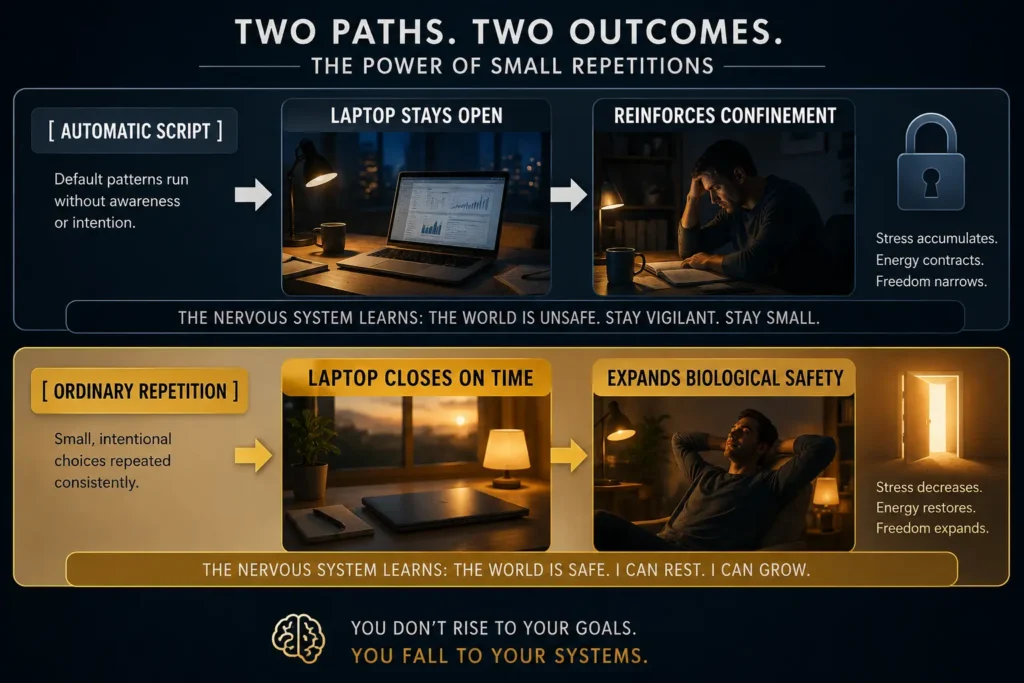
When you close your laptop at a designated hour despite a full inbox, or when you choose to be intentionally present with your family over an extra hour of performance maintenance, you are gently retraining your nervous system. You are proving to your biology that the absence of constant motion is entirely survivable. Over time, these deliberate choices accumulate, gradually adjusting your allostatic baseline until purpose stops feeling like a risk and begins to feel natural.
To locate the boundaries of your current container, confront these three diagnostic questions:
- What part of your life functions well enough that you have stopped imagining something better?
- Where have you confused external success with internal alignment?
- What small decision this week would move you toward significance instead of simply maintaining success?
From Success to Significance
Living beneath the ceiling of adequacy forces us to organize our lives entirely around production rather than purpose. We become exceptionally skilled at executing roles, yet entirely unpracticed at becoming ourselves. Over time, this structural gap creates a profound crisis of visibility. You can appear highly successful to the world while privately losing your sense of personal significance.
This dynamic sits at the heart of the research behind my work in The Mattering Effect. The greatest crisis facing many high achievers today is not a deficit of capability or resource; it is the gradual erosion of the belief that who they are matters beyond what they produce.
“Success becomes dangerous when it removes the urgency to become.”
John R. Miles
Breaking through the ceiling of adequacy is not an indictment of your achievements, nor does it require you to reject your success. It is simply a refusal to mistake the platform you built for the finish line. When success is the final goal, adequacy becomes a permanent resting place. When significance becomes the goal, adequacy becomes the launching point.
Every life eventually reaches a point where competence is no longer the primary challenge. The true challenge becomes whether we are willing to question the very behavioral patterns that made us successful in the first place. Your current conditioning is a valuable record of where you have been and how you survived. It holds no permanent authority over where you are going. The ceiling was never meant to become your horizon.
Every life eventually reaches a point where competence is no longer the challenge. The challenge becomes whether we are willing to question the very patterns that made us successful. The ceiling of adequacy is not a verdict on ambition or achievement. It is a reminder that success can become a resting place or a launching point. The difference lies in whether we continue measuring our lives by what we accomplish or by who we are becoming.
About the Author
John R. Miles is a former Fortune 50 C-level executive, combat veteran of the United States Navy, and the host of the Passion Struck podcast. As an author and keynote speaker, his work integrates behavioral science, human performance, and psychology to help individuals break automatic patterns and achieve lasting personal transformation. For more insights on behavioral adaptation and intentional living, subscribe to his weekly newsletter, The Ignited Life, on Substack.
I write every week about behavioral science, intentional living, leadership, and human flourishing in The Ignited Life on Substack. This week’s post is about what Jon Gordon’s burrito taught me about a hidden barrier to meaningful change.
If The Ceiling of Adequacy explains why successful people stop growing, The Mattering Effect explores why so many successful people quietly stop feeling significant.
Read: Why High Achievers Can Feel Invisible Despite Their Success
Frequently Asked Questions
What is the ceiling of adequacy?
The Ceiling of Adequacy is a psychological framework developed by John R. Miles that describes how external success can gradually become the very mechanism that prevents further transformation. As achievement, stability, and recognition accumulate, they create a functional container that reduces the perceived need for change while internal misalignment continues to grow. Because the costs of remaining the same are delayed, largely psychological, and hidden beneath continued performance, the Ceiling of Adequacy disguises stagnation as stability—turning comfortable success into an invisible barrier to significance, purpose, and human flourishing.
Why does real change feel so difficult for high achievers?
Real change feels difficult because the high performer’s nervous system treats constant motion, chronic pressure, and hyper-vigilance as its baseline safety setting. When peace or boundaries are introduced, the subconscious mind misinterprets the stillness as an uncharted threat, sparking acute internal anxiety and driving the individual back to familiar busyness.
How does the ceiling of adequacy differ from traditional failure?
Traditional failure leaves a person hungry and provides an explicit problem to solve. The ceiling of adequacy leaves a person structurally full yet existentially unsatisfied. Because the external components of life are stable and successful, the internal decay remains entirely hidden, masking the misalignment.
What is the connection between nervous system safety and human flourishing?
Human flourishing is not a violent battle to destroy your old identity or force yourself to become someone completely foreign. True transformation is about building trust with your biology. Flourishing happens when you use everyday repetition to gently teach your nervous system that a healthier, more intentional lifestyle is safe enough to call home.