
We often mistake success for a linear path, picturing a series of wins without a cloud in sight. In reality, the most significant victories are forged in the moments when things go wrong. It is often the sting of rejection and the weight of doubt that provide the necessary friction to sharpen a vision into something world-changing. The story of Jamie Siminoff, the mind behind Ring, serves as a masterclass in turning a public setback into a historic achievement.
In 2013, Siminoff walked onto the Shark Tank stage to pitch DoorBot—a video doorbell designed to let homeowners see and speak with visitors from anywhere. At the time, the company was already generating $1 million in annual sales, and Siminoff arrived with the quiet confidence of a founder who knew he had a hit.
However, the sharks weren’t convinced. Despite his passion and the product’s early traction, he walked away without a deal. For many entrepreneurs, a televised rejection of that magnitude would have been the end of the road. For Jamie, it was merely a data point.
What followed is one of the most famous “lost opportunities” in the show’s history. Rather than letting the rejection define the product’s value, Siminoff doubled down on his belief in the mission. He rebranded DoorBot to Ring, refined the technology, and leaned into the idea that home security should be accessible and connected.
His persistence paid off in a way few could have predicted: five years after being turned down on national television, Amazon acquired Ring for over $1 billion. This journey highlights a fundamental truth about success: it isn’t about avoiding the “no,” it’s about having an unbreakable belief in your vision that outlasts the skepticism of others.
The Early Days: A Tinkerer with a Vision
Success rarely arrives as a sudden epiphany; for Jamie Siminoff, it was the result of a lifelong habit of curiosity. Growing up in New Jersey, Jamie was the quintessential tinkerer—the kind of kid whose room was a permanent construction zone of discarded parts, half-finished gadgets, and tools. He didn’t just play with toys; he took them apart to understand the mechanics of how the world worked.
That innate drive to solve problems followed him to Babson College, an environment designed for those who see the world through the lens of entrepreneurship. Jamie wasn’t there just to earn a degree; he was there to find friction points in everyday life and build ways around them. He was constantly asking a single, driving question: “How can I make this better?”
However, the road to Ring was paved with ideas that never took flight. Jamie’s early ventures were often messy and faced significant hurdles. But this is where his true foundation was built. He began to view failure not as a stop sign, but as a necessary part of the creative process. Each unsuccessful project was a lesson in perseverance and a reminder that a vision is only as strong as the belief behind it.
These formative years turned Jamie into a resilient problem-solver who understood that pushing forward is the only way to find a breakthrough. He couldn’t have known it at the time, but a simple, everyday frustration—the nuisance of missing a delivery at his front door—was about to collide with his years of tinkering to create something that would change his life forever.
The Birth of DoorBot: A Simple Problem, A Big Solution
Now, let’s fast forward a few years. Jamie’s working in his garage—yes, the classic “garage inventor” story. And he’s constantly missing deliveries because he can’t hear the doorbell while he’s working. It’s a simple problem, but like all great entrepreneurs, Jamie’s mind immediately starts thinking of a solution. He realized that if he had this problem, other people probably did too.
That’s where the idea for DoorBot was born. He envisioned a device that would allow homeowners to see who was at the door and even communicate with them—no matter where they were, all through their smartphones. Sound familiar? It should. This was the precursor to what we now know as Ring.
But here’s the thing: turning an idea into reality is rarely easy. Jamie faced massive hurdles—funding, technical challenges, and market skepticism. Investors didn’t see the potential, and there were significant obstacles in making the device reliable, user-friendly, and affordable. But despite all of these challenges, Jamie didn’t give up.
He had belief in vision—the kind of belief that keeps you going when the world tells you no. He was determined to make DoorBot work, and that’s exactly what he did. After refining the product and launching it, DoorBot started making sales, and things were looking up. That initial success provided the validation he needed to keep pushing forward. But as any entrepreneur knows, making early sales is just the beginning. To take DoorBot to the next level, Jamie needed something more—more exposure, more investment, and more credibility.
And that’s when the opportunity to appear on Shark Tank came along.
The Shark Tank Rejection: A Turning Point
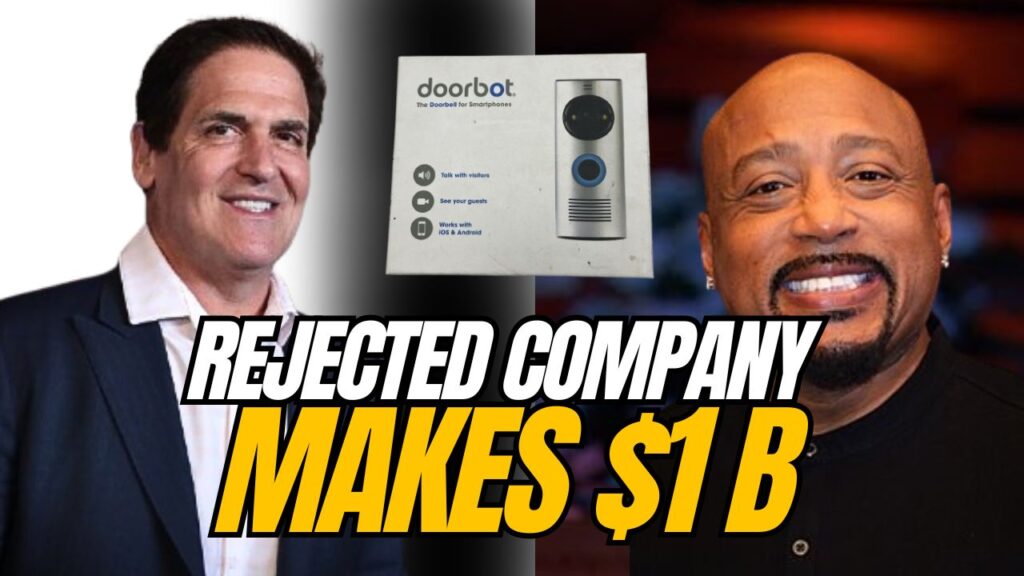
It’s 2013, and Jamie Siminoff walks into the Shark Tank studio, ready to pitch his heart out. Imagine the pressure—standing in front of some of the biggest names in business, knowing that this could be the moment that changes everything. At this point, DoorBot was doing $1 million in annual sales, which is no small number for a startup. Jamie had something good, and he knew it. He needed an investment to scale, to grow, to bring his vision to the masses.
So there he was, pitching his heart out, showing the sharks how DoorBot could revolutionize home security. But the sharks? They weren’t as convinced. All except Kevin O’Leary, who you probably know as ‘Mr. Wonderful.’ O’Leary offered a deal, but here’s the thing about Kevin—his deals come with a lot of strings. He offered a $700,000 loan in exchange for a royalty on every sale and a chunk of the company. Jamie knew that deal wasn’t right for him. It didn’t align with his vision for DoorBot, so he walked away—without a deal.
Imagine that. You’ve just put everything on the line, in front of millions of viewers, and you walk away empty-handed. For Jamie, this was a crushing blow. And I’m not gonna lie; he’s said in interviews that it was one of the lowest moments of his career. Getting rejected in front of millions of viewers—especially after putting so much into your pitch—can feel like a public failure.
But here’s where things get interesting. Instead of letting this rejection define him, Jamie used it as fuel. He realized that even though he didn’t get the deal, he had just received an incredible amount of exposure. Millions of people had just seen his product, and that visibility was priceless.
So, rather than retreat from Shark Tank rejection, Jamie doubled down. He focused on refining DoorBot, addressing the concerns the sharks had raised, and capitalizing on the publicity from the show. This period of reflection and adjustment became a pivotal moment in his journey. He took what could have been a failure and turned it into an opportunity for growth. This, my friends, is one of the most important lessons we can learn from Jamie Siminoff’s story: setbacks are inevitable, but they don’t have to define you. It’s how you respond to them that matters.
The Transformation: From DoorBot to Ring
Now, this is where things get really interesting. Jamie knew that to take DoorBot to the next level, he needed to make some changes. So, he rebranded the product. DoorBot became Ring—a name that was more appealing and more in line with Jamie’s vision for the company.
But it wasn’t just about the name. Jamie made significant improvements to the product itself. He focused on making it more reliable, enhancing the video quality, and improving the overall user experience. He listened to customer feedback and used it to drive innovation. This is another key lesson: innovation doesn’t stop once your product hits the market. It’s a continuous process, one that requires you to stay in tune with your customers and constantly look for ways to improve.
And let me tell you, this wasn’t easy. Jamie faced stiff competition from other tech companies entering the smart home market. But instead of backing down, he pushed harder. He forged strategic partnerships with major retailers, expanded the company’s reach, and invested heavily in customer support. Jamie understood something that many entrepreneurs overlook: your customers are your greatest asset. If you focus on providing them with an exceptional experience, they’ll stick with you—and they’ll tell others.
This relentless focus on customer satisfaction paid off. Ring began to gain serious traction, and Jamie started attracting more investors. In 2015, Sir Richard Branson stepped in, investing $28 million into Ring. That was a huge turning point for the company. Branson saw the potential that the sharks missed, and his investment gave Jamie the resources he needed to continue growing the business. But Jamie didn’t stop there. He kept hustling, kept innovating, and kept looking for ways to make Ring the best it could be.
One of the smartest moves Jamie made was securing a partnership with Amazon. That deal put Ring in front of millions of customers, and it didn’t take long for Ring to become one of the best-selling home security products on the market. Sales soared, and Jamie’s persistence paid off in a big way.
The Amazon Acquisition: A Billion-Dollar Milestone
As Ring continued to grow, it caught the attention of Amazon, a company that was looking to expand its smart home offerings. In 2018, Amazon acquired Ring for a reported $1 billion. Yes, you heard that right—one billion dollars. Now, think back to Jamie’s Shark Tank pitch. Mark Cuban—one of the sharks—had doubts that DoorBot could even reach a $90 million valuation, let alone a billion-dollar one.
But Jamie didn’t let those doubts stop him. He believed in his vision, and that belief, combined with relentless hard work and innovation, led him to build a company that Amazon saw as a crucial piece of their future in the smart home space.
But here’s the thing. The Amazon acquisition wasn’t just a payday for Jamie. It came with its own set of challenges. Jamie had to integrate Ring into Amazon’s vast ecosystem while making sure that Ring kept its unique identity and customer-first approach. And let me tell you, that’s no easy feat. But under Jamie’s leadership, Ring has flourished. The company has expanded its product line, introducing new devices and features that make home security even more accessible and convenient. And through it all, Jamie has remained committed to the same vision he had back in his garage—solving problems and making people’s lives better.
Here is an updated version of these lessons, focused on making the insights feel more actionable and keeping the narrative energy high:
6 lessons from Jamie Siminoff’s journey
Jamie Siminoff’s transition from a televised rejection to a billion-dollar exit offers a blueprint for anyone navigating the messy middle of a dream. Here are the core principles that fueled his trajectory:
1. Protect your conviction
This is the bedrock of the entire journey. Jamie never allowed the skepticism of others to dilute his own belief in the product. When the sharks doubted the market and investors closed their doors, he remained anchored to the idea that his vision could fundamentally change home security. If you aren’t the primary advocate for your vision, you can’t expect the world to catch up to it.
2. Resilience as a competitive advantage
Rejection isn’t an obstacle to the process; it is the process. Jamie didn’t view the Shark Tank experience as a definitive judgment on his worth, but as a high-profile hurdle to clear. Resilience is the ability to use the energy of a “no” to find the next “yes.” It turns a potential breaking point into a pivot point.
3. The cycle of continuous innovation
Success is never a static destination. Even after gaining traction, Jamie stayed in the mindset of a tinkerer. By constantly refining the technology, expanding the product ecosystem, and obsessing over the user interface, he ensured that Ring didn’t just exist in the market—it led the market.
4. Extracting value from setbacks
Every failure contains a specific set of data. Rather than retreating after his pitch failed to land a deal, Jamie analyzed the gaps and used the national exposure to refine his branding. He turned a public setback into a catalyst, proving that the most powerful growth often happens right after a stumble.
5. Leverage strategic alignment
Jamie recognized that scale requires more than just hard work; it requires the right ecosystem. By aligning with partners like Sir Richard Branson and eventually Amazon, he gained the credibility and infrastructure necessary to reach millions. Growth is often accelerated by finding partners whose strengths bridge your specific gaps.
6. Obsess over the mission to serve
At its core, Ring succeeded because it solved a genuine human frustration. Jamie maintained a relentless focus on customer satisfaction, treating feedback as a roadmap for improvement. When you focus on delivering undeniable value to the people you serve, the financial and professional milestones tend to take care of themselves.
Final Thoughts: Moving Forward with Confidence
Jamie Siminoff’s journey from a garage inventor to the founder of a billion-dollar company is a powerful reminder that success isn’t a straight path. It’s filled with twists, turns, setbacks, and challenges. But if you believe in your vision, stay resilient, and keep pushing forward, anything is possible.
Whether you’re an entrepreneur or someone pursuing a personal goal, the lessons from Jamie’s story are universally applicable. Believe in your vision. Be resilient in the face of rejection. Embrace innovation. Build strategic partnerships. And most importantly, always focus on the people you serve.
So, I want to leave you with this: What’s your vision? What’s that big idea or goal you’re working toward? And how will you respond when you face rejection or obstacles? Remember, it’s not about avoiding failure—it’s about how you bounce back and use it to propel you forward.
Success isn’t about avoiding failure—it’s about using it as fuel to keep moving forward. So, go out there and chase your dreams. Stay passionate, stay resilient, and keep striving for greatness.