
If you want to discover your true self, you often have to go to the last place you’d ever choose: the bottom of a major life crisis.
Table of Contents
- Resume Virtues vs Eulogy Virtues
- The Island: When Your Old Identity Disappears
- The Rope in the Pit
- Subtraction Before Addition: The Sculptor Principle
- The Diagnostic Power of Adversity
- How to Develop Eulogy Virtues Through Adversity
- The Return
- Frequently Asked Questions
Adversity doesn’t build character — it reveals it. It strips away the resume virtues (the skills, achievements, and polish we show the world) and forces the eulogy virtues (integrity, resilience, courage, kindness, and inner strength) to surface.
Two powerful stories show exactly how this happens: Tom Hanks in Cast Away and Christian Bale in The Dark Knight Rises.
Resume Virtues vs Eulogy Virtues
David Brooks introduced the powerful distinction in his book The Road to Character and his New York Times essay “The Moral Bucket List.”
Resume virtues are the external skills that help you succeed in the marketplace: competence, drive, efficiency, credentials, and accomplishments.
Eulogy virtues are the inner qualities remembered at your funeral: kindness, bravery, honesty, resilience, integrity, and the capacity for deep love.
Most people optimize for resume virtues. Then adversity hits — divorce, illness, job loss, financial ruin, or personal failure — and suddenly those resume virtues sink. What’s left are your eulogy virtues.
The Island: When Your Old Identity Disappears
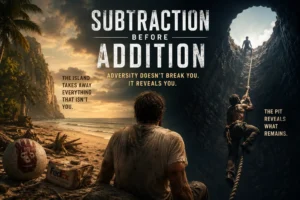
In Cast Away, Chuck Noland is the ultimate high-performance executive, obsessed with time and efficiency. After a plane crash, he’s stranded on a deserted island. Everything that defined him — his title, schedule, pager, and status — vanishes.
The island forces radical subtraction. With no audience and no performance left, Chuck meets his baseline self. Many people today are living on their own “island.” They’re exhausted not just by the hardship, but by clinging to an old identity that no longer fits.
During these crises, the brain enters heightened plasticity. The old map stops working, and you begin rewriting who you are.
The Rope in the Pit
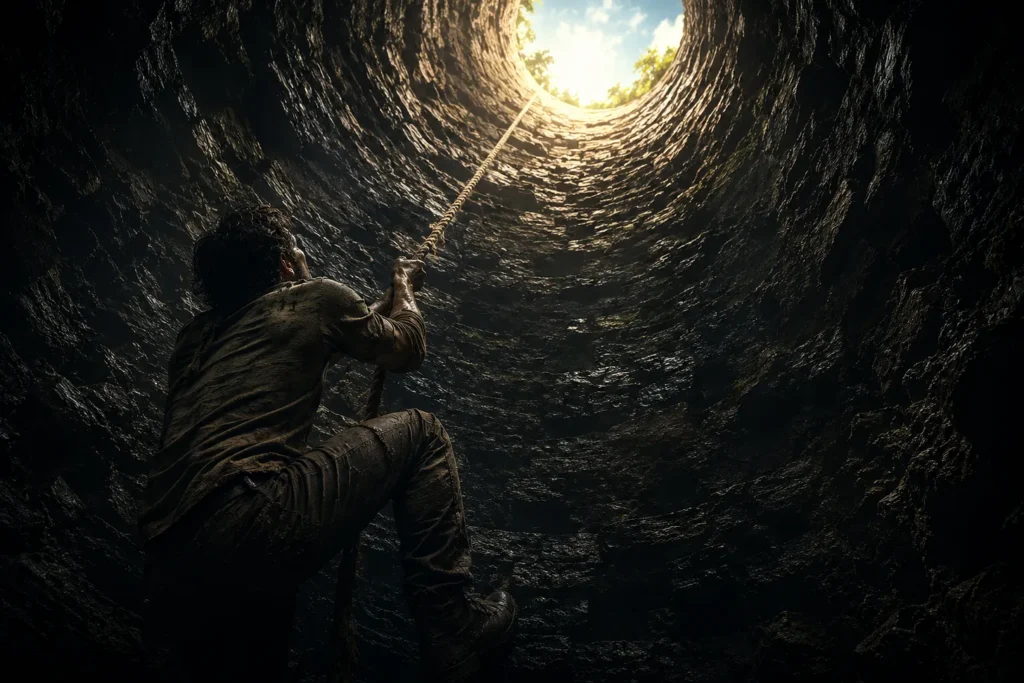
In The Dark Knight Rises, Bruce Wayne is trapped in a deep underground prison called the Pit. He fails to climb out twice — not because he lacks strength, but because of the rope tied around his waist. The rope feels like safety. In truth, it prevents total commitment.
That rope exists in real life as ego, past success, backup plans, and old identities. As long as you cling to it, you’ll never make the full leap.
Subtraction Before Addition: The Sculptor Principle
Adversity works like a sculptor. It doesn’t add — it removes everything that isn’t the masterpiece. The pain you feel is the sound of the unnecessary falling away so your real self can emerge.
The Diagnostic Power of Adversity
At the bottom of a crisis, you finally see your true foundation. Adversity asks one essential question:
When there is nothing left to hide behind — no titles, no achievements, no reputation — who are you?
That answer reveals your eulogy virtues.
How to Develop Eulogy Virtues Through Adversity
- Recognize the Island Phase — Accept that your old identity no longer fits.
- Identify Your Rope — Name the safety nets and ego attachments holding you back.
- Allow Subtraction — Let go of what no longer serves you.
- Meet Your Baseline Self — Discover who you are without external validation.
- Make the Leap — Commit fully and move from endurance to agency.
- Return Stronger — Live from your eulogy virtues in a world that still rewards resume virtues.
The Return
The real transformation shows up after the crisis. You come back carrying deeper eulogy virtues — making decisions with less noise, stronger boundaries, and clearer purpose. You no longer fear adversity, because you know it reveals who you truly are and why you matter.
Drop the rope. Let the chisel do its work.
Your eulogy virtues — and the most authentic version of your life — almost always emerge at the bottom.
Frequently Asked Questions
-
What is the difference between resume virtues and eulogy virtues?
-
Resume virtues are the external skills and marketplace assets like competence, drive, efficiency, and credentials that define professional success.
-
Eulogy virtues are the internal, moral qualities remembered at the end of a life, such as integrity, resilience, courage, kindness, and the capacity for deep love.
-
While most people spend their lives optimizing for resume virtues, major life crises often cause these external markers to sink, forcing the eulogy virtues to the surface.
-
-
How does adversity reveal your true character?
-
Adversity acts as a diagnostic tool that strips away the resume virtues and “polish” we typically show the world.
-
When titles, achievements, and reputations are removed, you are forced to confront your baseline self.
-
This process reveals the internal foundation of integrity and inner strength that remains when there is nothing left to hide behind.
-
-
What is the sculptor principle in personal growth?
-
The sculptor principle suggests that adversity does not add new qualities to a person, but rather removes everything that is not the masterpiece.
-
In this framework, the pain of a crisis is viewed as the sound of unnecessary layers—such as old identities or ego attachments—falling away so the authentic self can emerge.
-
-
What does “dropping the rope” represent in a life crisis?
-
Inspired by the pit analogy in The Dark Knight Rises, the rope represents safety nets, ego, past successes, and backup plans that provide a false sense of security.
-
Clinging to these attachments prevents a person from making the total commitment necessary to successfully navigate a transition or make a full “leap” toward a new identity.
-
Dropping the rope means letting go of these old safety nets to achieve true transformation.
-
-
What is the island phase of a crisis?
-
Derived from the movie Cast Away, the island phase is a period of radical subtraction where the external markers of identity—such as status, schedules, and professional titles—completely vanish.
-
This phase creates a state of heightened neuroplasticity where the “old map” of your life no longer works, allowing you to rewrite who you are from a baseline level.
-
-
How can you develop eulogy virtues during a period of hardship?
-
The process begins by accepting the island phase and recognizing that an old identity no longer fits the current reality.
-
It requires identifying the ego attachments (the rope) holding you back and allowing the process of subtraction to remove what no longer serves you.
-
By meeting your baseline self without the need for external validation, you can move from a state of endurance to one of active agency, eventually returning to the world with clearer purpose and stronger boundaries.
-