
The Leadership Gap That Strategy Can’t Close
Every year, corporations across the United States spend billions of dollars training leaders in competitive strategy, financial modeling, market positioning, and operational frameworks. Yet employee engagement remains stuck near historic lows, manager-employee trust continues to erode, and burnout has become the defining crisis of the modern workplace. Something critical is being left out of the leadership development equation and it is not another strategy module.
The missing element is emotional intelligence. According to research,90% of top performers in the workplace possess high emotional intelligence, while EQ accounts for 58% of success across virtually all job roles. Yet only 42% of organizations globally conduct any formal emotional intelligence workshops for senior management, a staggering gap between what the science shows and what companies actually invest in.
At JohnRMiles.com, human performance expert and bestselling author John R. Miles has spent decades helping leaders and organizations close exactly this gap. His research-backed work on intentional living, the Mattering Revolution, and human flourishing consistently points to the same conclusion: sustainable, high-performance leadership is built from the inside out — beginning with emotional intelligence.
This blog makes the case for why emotional intelligence workshops are the most powerful investment a company or individual leader can make.
What Are Emotional Intelligence Workshops?
Emotional intelligence workshops are structured learning experiences designed to develop a leader’s capacity to recognize, understand, manage, and apply emotions — both their own and those of the people around them. Unlike traditional leadership training that focuses on external tools and models, emotional intelligence workshops work on the internal architecture of how a person leads.
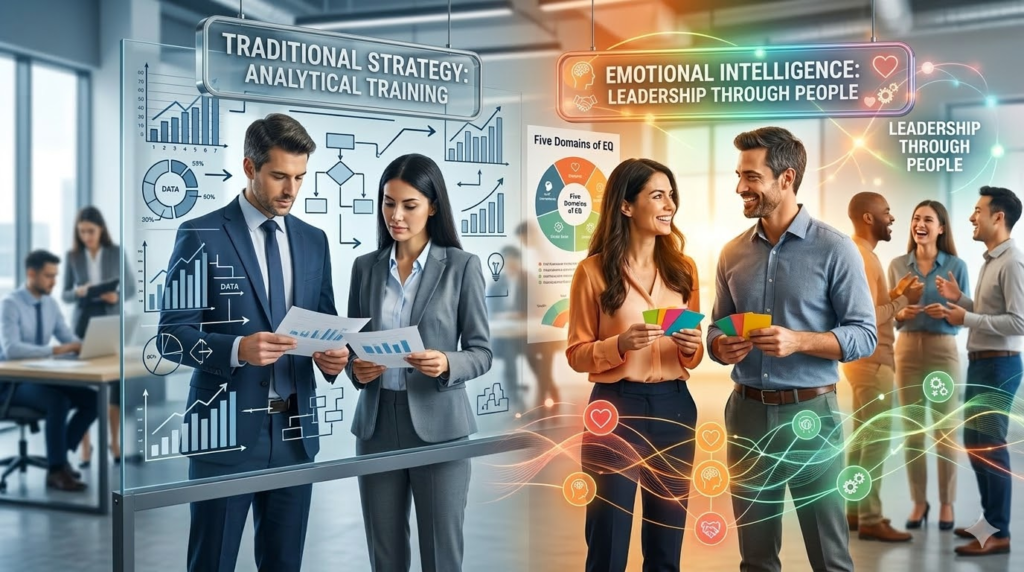
Effective EQ leadership programs typically address five core domains, first identified by psychologist Daniel Goleman and now supported by decades of organizational research:
- Self-awareness — recognizing your own emotional states and their impact on behavior
- Self-regulation — managing emotional responses, especially under pressure or conflict
- Intrinsic motivation — sustaining energy and purpose through internal rather than external drivers
- Empathy at work — reading and responding to the emotional states of colleagues, reports, and stakeholders
- Social skills — building influence, resolving conflict, and leading through relationships
What separates great emotional intelligence workshops from generic soft-skills training is their use of validated psychometric assessments, real-world scenario practice, peer feedback loops, and deliberate behavioral reinforcement over time. The best programs don’t just explain emotional intelligence, they create the conditions for it to grow.
The Problem With Strategy-Only Leadership Training
Strategy training is not without value. Understanding competitive dynamics, financial principles, and operational frameworks gives leaders important context for decision-making. The problem is when strategy training is treated as sufficient, when it becomes the primary or exclusive investment in leadership development.
Strategy frameworks tell leaders what decisions to make. Emotional intelligence determines how those decisions get implemented through people. And it is in the human dimension of leadership that most strategies succeed or fail.
Consider the most common reasons leaders derail in their careers according to research by the Center for Creative Leadership: poor interpersonal relationships, difficulty managing change, inability to build and lead teams, and failure under pressure. None of these are strategy failures. They are emotional intelligence failures like specifically, failures in emotional regulation, empathy at work, and self-awareness.
Strategy training doesn’t address why a high-performing manager becomes defensive in conflict. It doesn’t explain why a technically brilliant executive struggles to inspire loyalty. It can’t resolve the emotional disconnection that drives an employee from a 76% engagement rate down to quiet quitting. These are the gaps that emotional intelligence workshops are uniquely positioned to close.
Strategy Training vs. Emotional Intelligence Workshops — What Each Develops
| Dimension | Strategy Training | EQ Leadership Workshops |
| Focus | External tools, models, competitive analysis | Internal awareness, emotional regulation, empathy |
| Skill Type | Analytical and technical | Interpersonal and behavioral |
| Performance Gap Addressed | What to decide | How to lead people through decisions |
| Team Impact | Indirect — via better plans | Direct — via trust, engagement, and safety |
| Retention Effect | Low | High — EQ programs linked to 30% turnover reduction |
| Derailment Prevention | Minimal | High — addresses top causes of leadership failure |
| Longevity of Impact | Fades as market conditions change | Compounds over time with practice |
How EQ Leadership Transforms the Five Dimensions of Leadership
1. Self-Awareness: The Foundation That Strategy Cannot Build
No leadership model can compensate for a leader who does not understand how their behavior affects others. Self-awareness is the ability to accurately read your own emotional states, triggers, and patterns is the foundational competency from which all other leadership capabilities grow.
Emotional intelligence workshops develop self-awareness through tools like 360-degree feedback, journaling practices, mindfulness-based exercises, and EQ assessments such as the EQ-i 2.0 or the Mayer-Salovey-Caruso Emotional Intelligence Test. Leaders who complete structured self-awareness work typically report significant shifts in how they respond to conflict, pressure, and uncertainty not because they learned a new framework, but because they learned themselves.
2. Emotional Regulation: Leading With Clarity Under Pressure
Emotional regulation is the capacity to manage one’s internal states and impulses, particularly in high-stakes moments. In today’s VUCA (volatile, uncertain, complex, ambiguous) environments, this may be the single most valuable leadership skill a person can develop.
Leaders who lack emotional regulation escalate conflicts, make reactive decisions, and create psychological unsafety for their teams. Emotional intelligence workshops teach concrete regulation tools: reframing techniques, trigger mapping, mindful pausing, and physiological reset strategies drawn from neuroscience and military performance.
3. Empathy at Work: The Leadership Multiplier
Empathy at work is frequently misunderstood as simply being kind or agreeable. In leadership terms, empathy is a sophisticated cognitive and emotional skill: the ability to accurately perceive the emotional state of another person and use that perception to inform your response, communication style, and decision-making.
Emotional intelligence workshops develop empathy through active listening drills, perspective-taking exercises, narrative sharing, and guided feedback practice. Crucially, they do this in experiential, peer-driven formats that mirror the real social dynamics of the workplace. This makes the learning far more durable than theoretical models alone.
4. Intrinsic Motivation: Sustaining Performance Without Burning Out
One of the most under-examined dimensions of EQ leadership is intrinsic motivation — the ability to remain energized and directed by internal purpose rather than solely by external rewards, titles, or recognition. Leaders who are only extrinsically motivated tend to perform well in stable, high-reward environments but crumble under pressure or ambiguity.
This is directly connected to the work of John R. Miles, whose Passion Struck framework identifies a sense of mattering, feeling that one’s contributions are genuinely significant as the primary driver of sustained human performance. Emotional intelligence workshops that address intrinsic motivation help leaders reconnect with their core purpose, align their leadership style with their values, and build the resilience needed to sustain performance without burning out.
5. Social Skills: The Execution Engine of Leadership
Strategy is only as good as its execution and execution is entirely a social act. The ability to influence without authority, navigate conflict constructively, build coalitions, communicate across diverse perspectives, and inspire discretionary effort are all functions of social skill development rooted in EQ.
Emotional intelligence workshops that target social skill development are among the highest-ROI investments an organization can make. Research consistently shows that targeted EQ programs drive engagement gains of around 20% and turnover reductions of approximately 30% in organizations that implement them systematically.
What Makes Emotional Intelligence Workshops Most Effective?

Not all emotional intelligence workshops deliver equal results. Research on what separates high-impact EQ programs from ineffective ones points to a consistent set of design principles:
Elements That Determine the Effectiveness of EQ Leadership Workshops
| Design Element | Lower-Impact Programs | Higher-Impact Programs |
| Assessment | Generic self-reflection prompts | Validated EQ instruments (EQ-i 2.0, MSCEIT) |
| Format | One-time lecture or seminar | Experiential, peer-driven, multi-session |
| Feedback Loop | Facilitator-only feedback | 360-degree + peer + self-assessment |
| Application | Abstract role-plays | Real workplace scenarios and challenges |
| Reinforcement | None after the session | Ongoing coaching, check-ins, and accountability |
| Duration | Half-day or single day | Multi-week program with spaced practice |
The most transformative emotional intelligence workshops combine rigorous assessment with experiential practice, honest peer feedback, and structured reinforcement over time. They treat EQ development not as an event but as a process, one that unfolds across real leadership challenges rather than simulated ones.
EQ Leadership in Practice: What Changes for Leaders and Teams
For Individual Leaders
Leaders who complete high-quality emotional intelligence workshops consistently report improvements in three key areas: greater clarity about their behavioral patterns and blind spots, stronger capacity to regulate their responses under pressure, and more authentic and effective communication with direct reports and peers.
For Teams
Teams led by emotionally intelligent leaders operate in fundamentally different conditions. They experience higher psychological safety, which research consistently links to greater innovation and discretionary effort. They navigate conflict more constructively because their leader models emotional regulation rather than reactivity. They report higher engagement, stronger belonging, and lower intent to leave.
For Organizations
At the organizational level, the business case for EQ leadership is compelling. People with high emotional intelligence are 50% more likely to succeed in leadership roles. Leaders with higher EI are 4 times more likely to earn promotions, and organizations with emotionally intelligent cultures are twice as likely to meet or exceed financial targets. These are not soft outcomes, they represent direct competitive advantage.
Conclusion: Strategy Tells You What to Do. Emotional Intelligence Makes You Capable of Doing It.
The most important insight from decades of leadership research is deceptively simple: technical competence gets you into a leadership role, but emotional intelligence determines how effectively you perform in it. Strategy training gives leaders sharper tools. Emotional intelligence workshops give leaders the capacity to actually wield those tools in service of the people they lead.
In an era where worker disconnection is epidemic, trust in leadership is at historic lows, and burnout has become the dominant occupational hazard, the organizations that invest seriously in emotional intelligence workshops are not just being compassionate, they are being strategically smart. The data is unambiguous. EQ leaders outperform. EQ cultures outperform. EQ is the highest-leverage investment in human capital that most organizations are still dramatically undermaking.
If you are ready to build leaders who create lasting impact, not just leaders who can read a strategy deck — explore the human performance and intentional leadership frameworks developed by John R. Miles.
Frequently Asked Questions
Q1: What is the difference between emotional intelligence workshops and soft skills training?
Emotional intelligence workshops use validated psychometric assessments and structured behavioral practice to develop specific EQ competencies. Soft skills training is often broader and less measurable. EQ workshops target identifiable capacities like self-awareness, emotional regulation, empathy and measure growth against a baseline over time.
Q2: Can emotional intelligence actually be taught, or is it fixed?
Emotional intelligence is highly trainable. Research consistently shows that targeted EQ programs improve communication, conflict resolution, and stress management. Unlike IQ, which remains relatively stable, EQ can develop meaningfully across a person’s lifetime with intentional practice and feedback-rich environments.
Q3: How does empathy at work differ from general workplace kindness?
Empathy at work is a cognitive and perceptual skill, the ability to accurately read another person’s emotional state and use that information to guide your response. It is not about agreement or softness. Empathic leaders can deliver difficult feedback, make hard calls, and hold high standards while still being perceived as deeply trustworthy by their teams.
Q4: How long does it take to see results from EQ leadership development?
Research suggests that meaningful behavioral change from emotional intelligence workshops begins within four to eight weeks when programs include structured reinforcement. Full integration into a leader’s default style typically takes three to six months of deliberate practice, peer feedback, and real-world application beyond the classroom setting.
Q5: Are emotional intelligence workshops relevant for senior executives, or just emerging leaders?
EQ leadership development is arguably most impactful at the senior level. A C-suite leader’s emotional patterns influence thousands of people downstream. Senior leaders who develop self-awareness, emotional regulation, and empathy at work create systemic cultural shifts that no strategy initiative can replicate independently.